

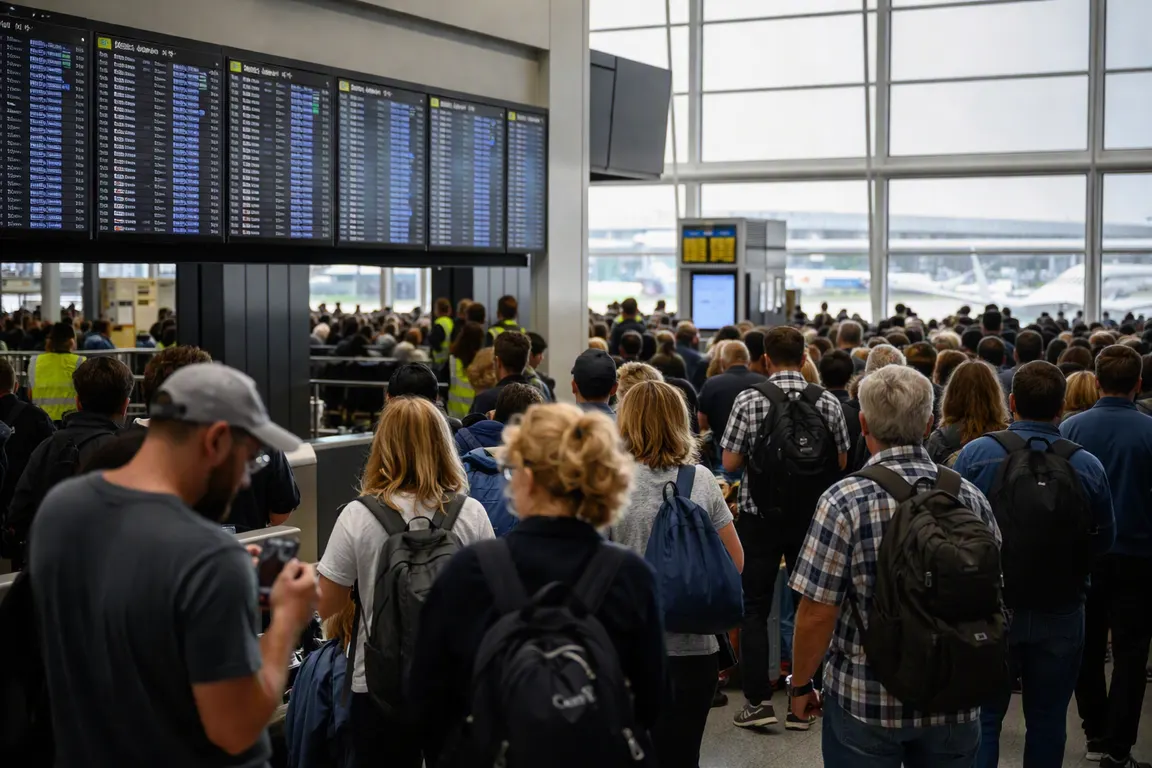
A Verizon fiber cut near an Amtrak line in New Jersey severed the primary communications circuit for the Philadelphia Terminal Radar Approach Control (TRACON). Within minutes the Federal Aviation Administration ordered ground stops at Newark (EWR), Philadelphia (PHL) and Teterboro (TEB), later extending the restriction to New York’s JFK and LaGuardia airports and to Westchester County Airport (HPN). The outage stranded thousands of passengers, delayed cargo and exposed a single‑point failure in a critical air‑traffic corridor.
The cut occurred at about 10:00 a.m. ET, when the primary fiber to Philadelphia TRACON went down. FAA Administrator Bryan Bedford said the backup fiber was already inoperative, leaving the control center without a redundant path. By 10:05 a.m. the FAA issued ground‑stop orders for Newark, Teterboro and Philadelphia; a half‑hour later the order was broadened to include JFK, LaGuardia and Westchester. At 11:07 a.m., average departure delays at Newark had risen to roughly 90 minutes, with 92 cancellations and about 70 diversions, according to Flightradar24 data.
Verizon attributed the outage to a contractor‑related cut and said its facilities functioned normally until the damage occurred. The company stopped short of accepting liability, noting the work was performed by an independent crew. The FAA initially described the problem as an “unknown equipment issue” before confirming the fiber cut, a shift that led to divergent reporting across outlets.
The incident is not isolated. Philadelphia TRACON experienced radio‑frequency outages in August 2025 and earlier in 2024, suggesting a pattern of recurring vulnerabilities. A 2023 Government Accountability Office report warned that the air‑traffic communication system is susceptible to both physical damage and cyber‑attack; in this case the cause was clearly mechanical.
Beyond passenger inconvenience, airlines faced crew‑positioning costs, additional fuel burn for diversions and delayed cargo shipments that ripple through East Coast supply chains. Industry sources estimate the immediate economic impact in the low hundreds of millions of dollars, though precise figures remain unverified.
The FAA announced a 13‑hour repair window for the splice and dispatched technicians to restore service. Bedford said the agency is reviewing redundancy protocols and will prioritize protective routing for critical circuits. Aviation industry groups have called for a federal mandate requiring multiple physically diverse pathways for all primary ATC communications, a proposal that could reshape infrastructure planning.
The episode raises two unanswered questions: how quickly can the FAA implement redundant routing across the Northeast corridor, and whether contractors and telecom operators will face stricter oversight to prevent similar cuts. As airports gradually resume limited operations, the incident underscores the fragility of the nation’s air‑traffic system and the need for policy action before the next splice halts the skies again.