

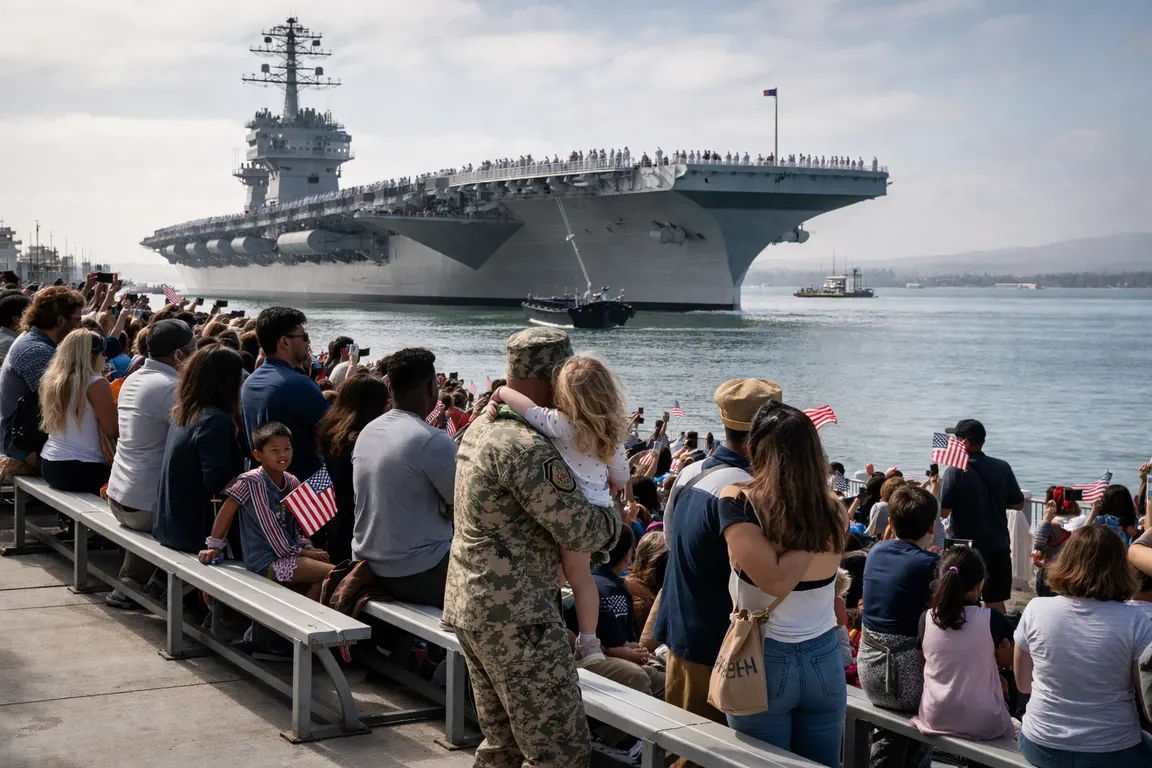
The nuclear‑powered carrier USS Abraham Lincoln (CVN‑72) slipped into San Diego Bay Thursday morning, ending a 322‑day deployment—the longest in its recent history. Families gathered on metal bleachers hours before the ship’s arrival, and service members were greeted by a sea of faces eager to reunite after more than ten months at sea.
The homecoming highlights growing strain on crew welfare and logistics. Sailors reported dwindling supplies, cramped living conditions and several suicide attempts during the deployment. With roughly 5,000 sailors aboard, those issues could affect future deployment cycles, recruitment and retention.
NBC News senior national security correspondent Courtney Kube reported from the carrier as the crew prepared to disembark. She noted that supply shortfalls became a recurring problem, with crews rationing food and personal items as the months wore on. Limited shore leave added to the stress, and the Navy has not issued an official explanation for the incidents or the supply gaps.
Military families expressed mixed emotions. While many celebrated the safe return of their loved ones, others voiced concern over the mental‑health crises that unfolded aboard the ship. One spouse, speaking on condition of anonymity, described the reunion as “a relief and a worry rolled into one,” noting that isolation and anxiety would likely linger long after the ceremony.
The public welcome drew thousands of spectators, underscoring the carrier’s symbolic importance to the community and the nation. Analysts note that a deployment of this length exceeds the Navy’s typical six‑month carrier cycle, suggesting a shift in operational tempo that may strain logistical pipelines and crew resilience. Without clear policy adjustments or additional mental‑health resources, the risk of repeat incidents grows.
The Navy has not released a formal statement addressing the supply shortages or the reported suicide attempts, leaving a gap in official accountability. As the crew begins debriefing and reintegration, service leaders are expected to review the deployment’s lessons. Whether that review will result in changes to rotation schedules, supply‑chain management or mental‑health support remains uncertain, but the spotlight on the Lincoln’s ordeal is likely to fuel congressional and public debate about the sustainability of current deployment practices.
For now, the sailors of the USS Abraham Lincoln are reuniting with families, and the base community is processing a homecoming that is both a celebration and a cautionary signal about the limits of endurance in modern naval operations.