

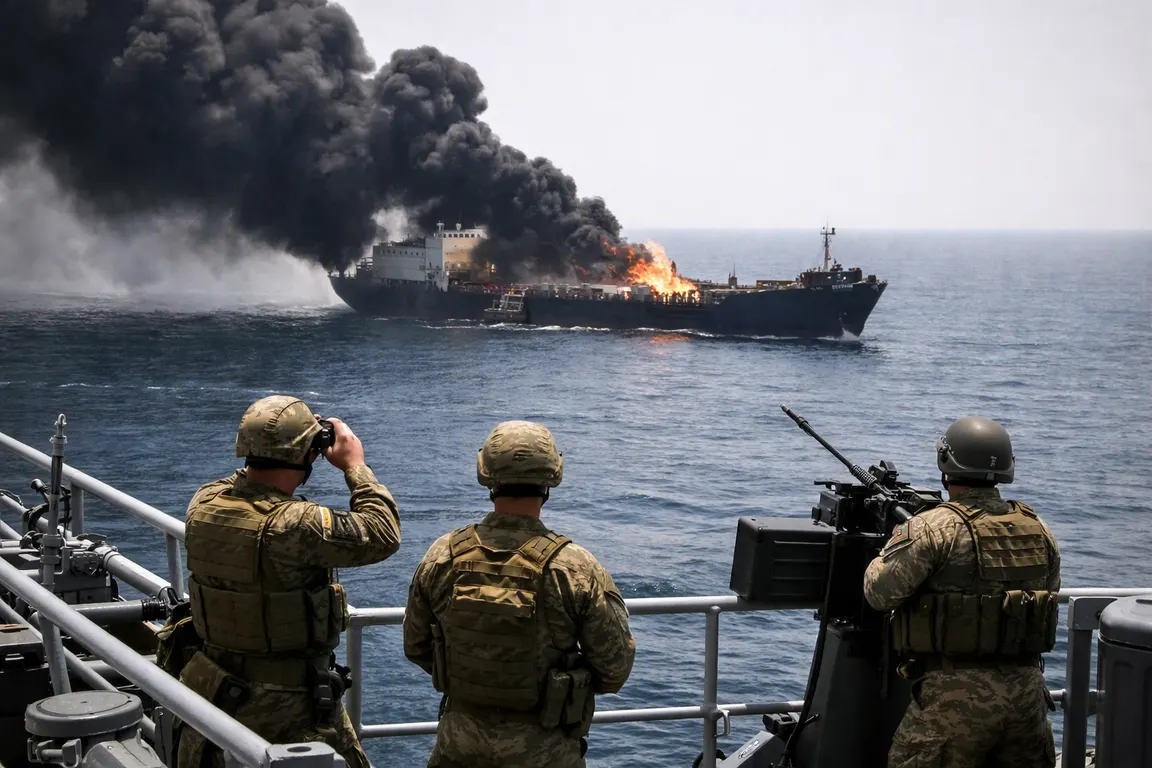
U.S. Central Command said Saturday it destroyed three IRGC tankers in the Gulf of Oman after the Islamic Revolutionary Guard Corps fired missiles at U.S. warships. The vessels – M/T Downy off Kharg Island, M/T Stark 1 near Jask and the empty M/T Kylo in the Gulf – were hit in a coordinated kinetic response.
Iran’s IRGC immediately claimed it had struck three oil tankers on an “unauthorized” route through the Strait of Hormuz and three U.S.-linked ships elsewhere. Independent verification of either side’s claims is pending; the United Kingdom Maritime Trade Operations reported no civilian casualties or confirmed hits on commercial ships at the time.
The exchange occurs amid a six‑month standoff that threatens the Hormuz corridor, a chokepoint through which roughly one‑fifth of the world’s oil passes. Washington paired the strikes with sanctions on a Turkish bank and on an Egyptian bank’s UAE operations, accusing both of financing the IRGC. The combined military and economic pressure marks a shift toward a blended strategy aimed at curbing Iran’s regional funding while keeping oil flow open.
U.S. officials framed the operation as defensive. CENTCOM said the three tankers were either empty (Kylo) or carrying crude (Downy, Stark 1) and that the IRGC missiles posed a direct threat to U.S. naval assets. Iran, however, described the Saturday attacks as retaliation, asserting its forces had hit three commercial tankers on a route it deemed “unauthorized” and three vessels it said were linked to the United States.
The latest flare‑up follows a fragile cease‑fire that collapsed in July after a series of attacks on commercial vessels in the strait. Earlier in September, U.S. forces raided Iranian maritime targets, setting a precedent for Saturday’s strikes. While Vice President JD Vance and former President Donald Trump dismissed the episode as “small potatoes,” the kinetic strikes and targeted sanctions suggest a more deliberate escalation.
For crews navigating the Hormuz corridor, the risk of sudden escalation is immediate. The strait’s narrowness and heavy traffic mean any miscalculation could impede oil flow, prompting price spikes in markets already feeling pressure from rising U.S. gasoline prices. Analysts warn that even a brief disruption could reverberate through downstream consumers, especially in regions dependent on imported fuel.
The sanctions announced the day after the strikes target financial institutions believed to facilitate IRGC transactions. By cutting off banking channels, Washington aims to choke the revenue stream that funds Iran’s maritime militia, complementing the physical destruction of assets.
Uncertainty remains over the true extent of the damage. Neither side has provided independent evidence confirming the destruction of the three tankers, and the IRGC’s claim of hitting three U.S.-linked vessels has not been corroborated by satellite imagery or third‑party observers. The lack of civilian casualties reported by the UKMTO does not rule out hidden losses, but it underscores the limited immediate human toll.
The next step is likely a diplomatic push to keep oil shipments flowing while both sides assess the cost of further retaliation. U.S. officials have signaled continued monitoring of traffic through Hormuz, and Iran has warned of “tougher reprisals” if its assets are targeted again. Whether the combined pressure of strikes and sanctions will deter future IRGC actions or provoke a deeper tit‑for‑tat cycle remains an open question, and the outcome will shape oil markets and maritime safety in the weeks ahead.