

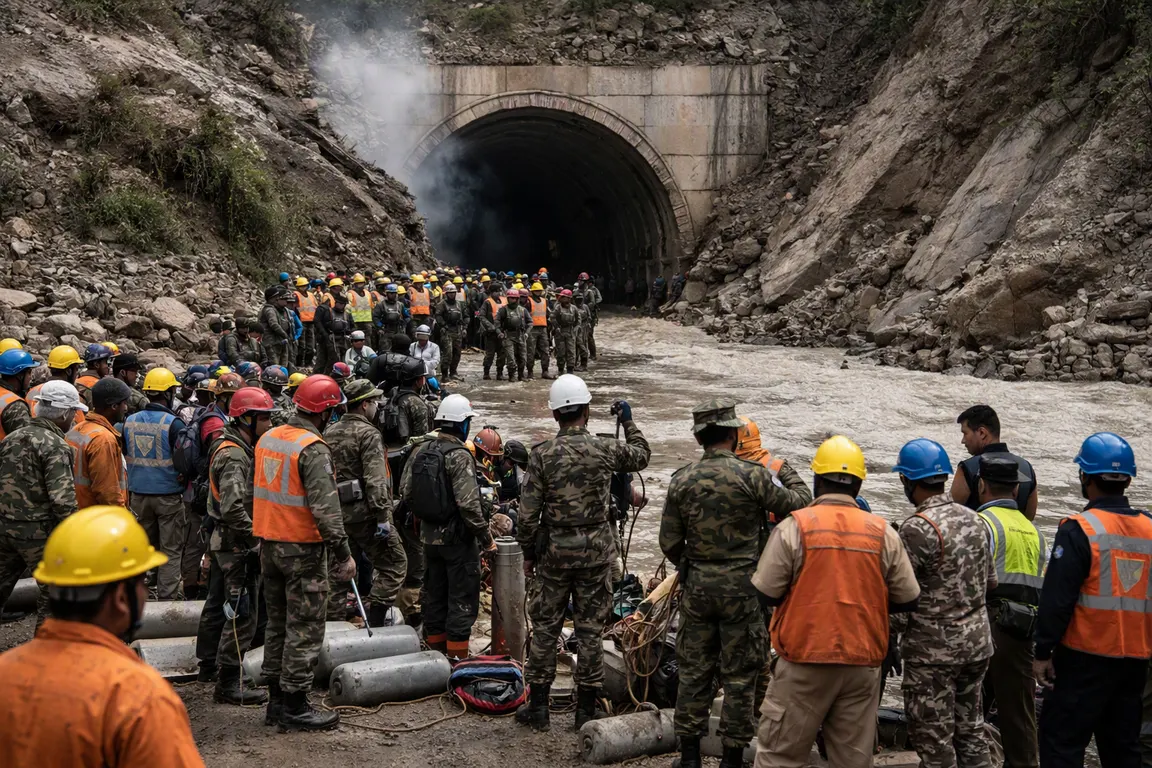
Rescue crews from Nepal, India and China are racing to locate more than 100 workers still trapped in the Trishuli‑3A tunnel after a glacial collapse triggered flash floods along the Nepal‑Tibet border on Wednesday. The disaster has killed at least 633 people in Nepal, left 2,426 missing and claimed seven lives on the Chinese side, according to the Manila Times.
Villages in Nuwakot, Rasuwa and Kathmandu districts were swept away; by Thursday more than 3,700 people had been rescued and hospitals in Kathmandu were still listing over 1,600 missing. A massive ice‑and‑rock surge broke off a glacier on the border, sending a debris torrent down the Trishuli River basin. The U.S. Geological Survey identified the event as a glacial collapse that generated the flash floods.
The most urgent technical challenge is the Trishuli‑3A tunnel. Of the 350 workers originally on site, 250 were evacuated, but more than 100 remain underground. Nepal’s army has begun drilling boreholes to pinpoint their location, while India has dispatched a specialized tunnel‑rescue team experienced in confined‑space operations. Chinese authorities have also sent helicopters to the border region.
Helicopter sorties, briefly halted by poor weather, resumed on Saturday, delivering food, clothing and medical supplies to stranded communities and evacuating the injured to field hospitals. A TikTok video posted hours before the flood proved unexpectedly useful: a daughter used the clip to locate the last known position of her mother and aunt on the Friendship Bridge, guiding rescuers to a previously unknown survivor site.
Beyond the immediate humanitarian response, the flood has exposed vulnerabilities in regional infrastructure. The Trishuli‑3A project, a cornerstone of Nepal’s renewable‑energy expansion, now faces an uncertain timeline as engineers assess damage to the tunnel and its intake structures. A prolonged shutdown could strain Nepal’s power grid, which already relies on electricity imports from India during peak demand.
India has responded by expanding its glacier‑lake monitoring program, now covering 1,266 lakes in Uttarakhand, to improve early detection of outburst floods. Nepal and China have pledged to improve cross‑border data sharing on glacial movement, though Chinese officials have provided limited casualty figures, citing ongoing assessments in the Tibet Autonomous Region.
Experts caution that while climate‑induced glacier melt raises the likelihood of such events, the precise trigger for this collapse remains unclear. The Indian Ministry of Environment described the cause as “uncertain,” while the USGS linked it to a debris‑torrent‑generating mechanism.
Families continue to rely on community networks and social media to locate missing relatives, underscoring the need for formal early‑warning systems. As rescue operations enter their second week, the next critical step will be the safe extraction of the tunnel workers and a comprehensive safety audit of the hydropower site.
The governments of Nepal, India and China now face a dual challenge: delivering immediate relief while establishing longer‑term policies to monitor glacial lakes, reinforce vulnerable infrastructure and coordinate cross‑border emergency protocols. How quickly these measures are institutionalized will determine whether the Himalayas are better prepared for the next climate‑driven shock.