

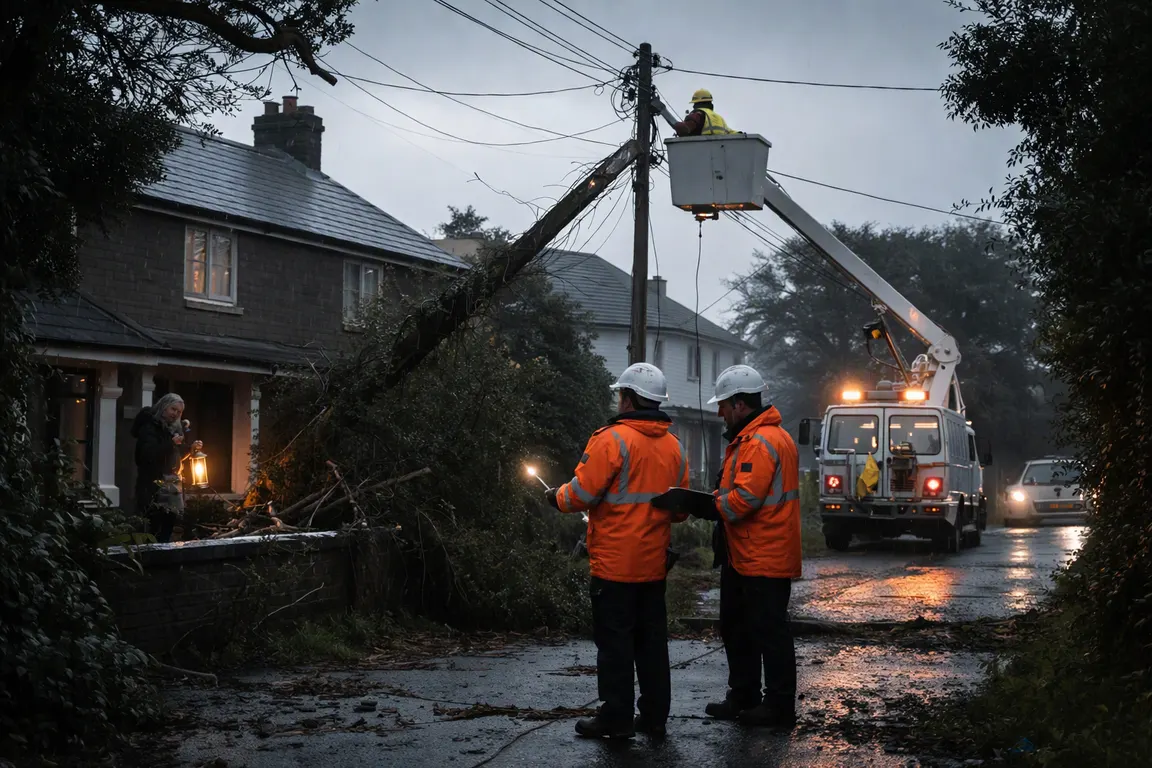
A gust of 76 mph recorded at St Mary’s Airport on the Isles of Scilly on Friday triggered the most severe phase of Storm Austen, causing a Storm Austen power outage that cut electricity to more than 16,000 homes across south‑west England and forced dozens of schools in Cornwall to close.
The timing is critical. Emergency services and utility crews are already stretched by Austen’s damage, and the Met Office has warned that Storm Boelo will bring high winds and heavy rain to Scotland, Northern Ireland and northern England on Saturday. The overlap raises the risk of compounded power outages, transport disruption and added strain on rescue resources.
The National Grid said that by mid‑morning power supplies had collapsed across the region after strong winds felled trees onto overhead lines. In Cornwall, local authorities ordered school closures as fallen timber blocked access routes and posed a safety hazard for pupils. Rail operators reported trees obstructing sections of the Great Western Main Line and several secondary routes, causing cancellations and delays that rippled through freight and commuter services. Road agencies said the A30, A38 and coastal routes near Penzance were intermittently closed while crews worked to clear debris.
BBC reports added that the storm’s impact extended beyond the mainland, with similar gusts recorded in Jersey. The Guardian noted “thousands of homes” without electricity, a figure that aligns with the National Grid’s count of over 16,000. No casualty figures have been released, and officials stressed that the primary threat remains loss of heating and safe travel as night falls.
Utility companies have mobilised crews from across the country, but the scale of the outage means restoration could take several days for the hardest‑hit households. The Department for Business, Energy & Industrial Strategy urged residents to conserve electricity where possible and to keep phones charged for emergency alerts.
In anticipation of Boelo, the Met Office forecast sustained winds of up to 60 mph in the north, accompanied by heavy rainfall that could trigger localized flooding. Transport operators are advising drivers to avoid exposed routes and to seek alternative corridors, while rail passengers are being redirected onto unaffected lines where possible. Freight firms have rerouted cargo away from the most disrupted ports, adding cost and delay to supply chains already feeling pressure from reduced rail capacity.
The situation highlights a broader challenge for the UK’s storm‑response framework. Climate models predict more frequent high‑impact weather events, and the need for coordinated planning between power networks, local councils and national agencies is becoming increasingly urgent. Lessons from Austen’s impact—particularly how quickly trees can bring down critical infrastructure—are likely to inform future investment in underground lines and vegetation management.
As Storm Boelo approaches, authorities will issue updated safety guidance throughout the weekend. Residents in the north are being asked to secure loose objects, check that roofs and windows are reinforced, and register with local councils for priority assistance if power is lost. The coming days will test whether the emergency response system can cope with back‑to‑back storms without a further escalation in outages or injuries.