

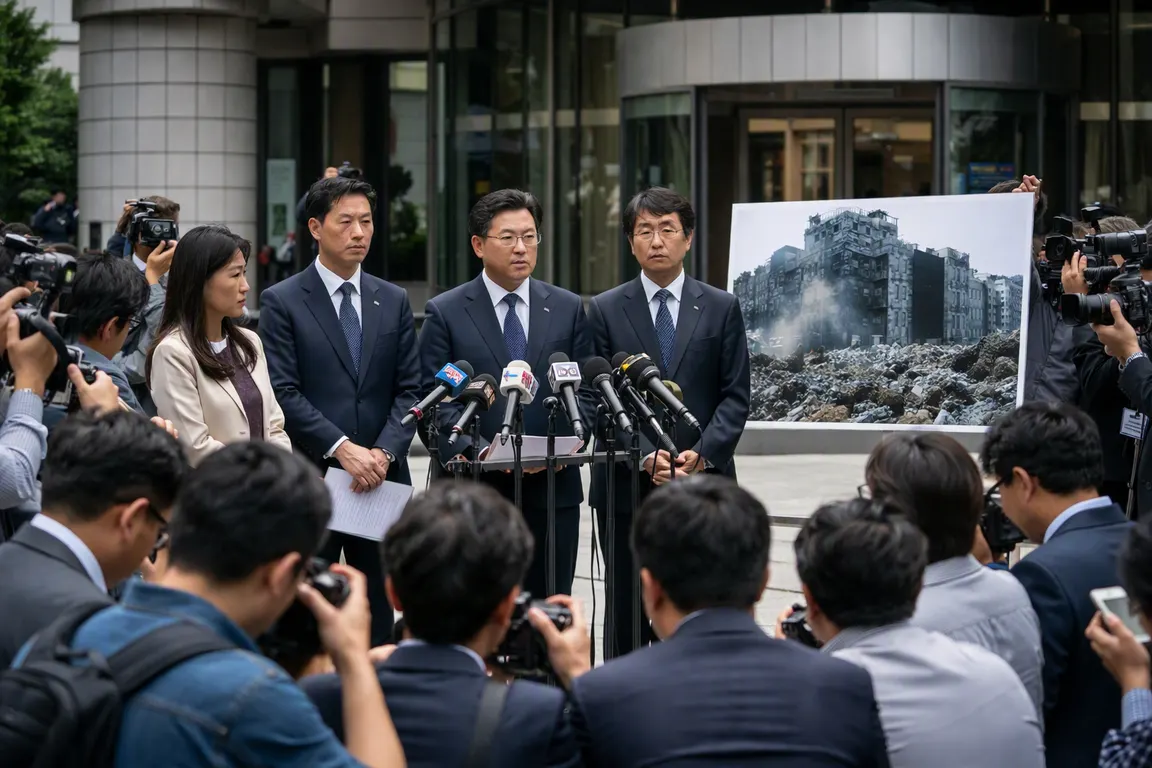
South Korea’s Seoul Central District Court on May 30 ordered North Korea to pay 44.6 billion won (about $32.5 million) in North Korea court damages for the 2020 demolition of the Inter‑Korean Liaison Office in Kaesong. It is the first time Seoul has sued Pyongyang for monetary compensation, creating a legal pathway for future inter‑Korean disputes, though experts doubt the sum will ever be collected.
The judgment reframes a symbolic act of aggression as a civil‑law claim, giving Seoul a diplomatic talking point and a potential lever in future talks. While the amount is a tiny fraction of South Korea’s budget, the decision signals a shift toward using legal mechanisms to press the North on compliance.
The liaison office, built inside the Kaesong Industrial Complex, opened in September 2018 as a joint venture to deepen economic and political ties. Roughly 20 officials from each side worked there until operations were halted in January 2020 amid the COVID‑19 pandemic. On June 16, 2020, after a flare‑up of balloon‑leaflet exchanges, North Korean soldiers demolished the building, drawing international condemnation. In 2023, under President Yoon Suk‑yeol, the South filed a lawsuit seeking compensation for the loss.
Judge Lee Hyun‑soo found the demolition violated international law and South Korea’s property rights, assigning liability of 44.6 billion won to the North. The Unification Ministry quickly clarified that the ruling is meant to “encourage dialogue” rather than force an actual payment, acknowledging the practical limits of enforcement.
Experts stress the judgment is largely symbolic. Hong Min of the Korea Institute for National Unification said Pyongyang is unlikely to honor the debt, noting the North has no foreign‑exchange reserves and no mechanism exists to seize assets abroad. The ruling therefore serves more as a political statement than a financial windfall, but it establishes a precedent that could be cited in future cases involving property damage, maritime incidents or other cross‑border disputes.
The fiscal impact on South Korea’s treasury is minimal; the amount is less than 0.1 percent of the 2024 budget. However, the decision may affect ongoing or prospective inter‑Korean projects, such as joint industrial ventures or tourism initiatives in Kaesong, by adding uncertainty for investors and businesses. Some Korean firms with interests in the region expressed concern that the ruling could signal a tougher stance from Seoul, potentially complicating negotiations on future economic cooperation.
Public reaction is mixed. A poll by the Korea Institute for Public Opinion found 42 percent of respondents view the ruling as a positive assertion of South Korea’s rights, while 35 percent see it as a symbolic gesture with little practical effect. Business groups have called for clear guidelines on how the judgment will be used in diplomatic talks, emphasizing the need for predictability.
The next steps are likely to involve diplomatic channels rather than courtroom enforcement. South Korean officials said they will monitor North Korea’s response and consider the ruling when shaping future dialogue strategies. Whether the judgment will translate into concrete concessions remains uncertain, leaving the court’s verdict as a noteworthy but largely rhetorical victory in the ongoing contest over the Korean Peninsula’s future.