

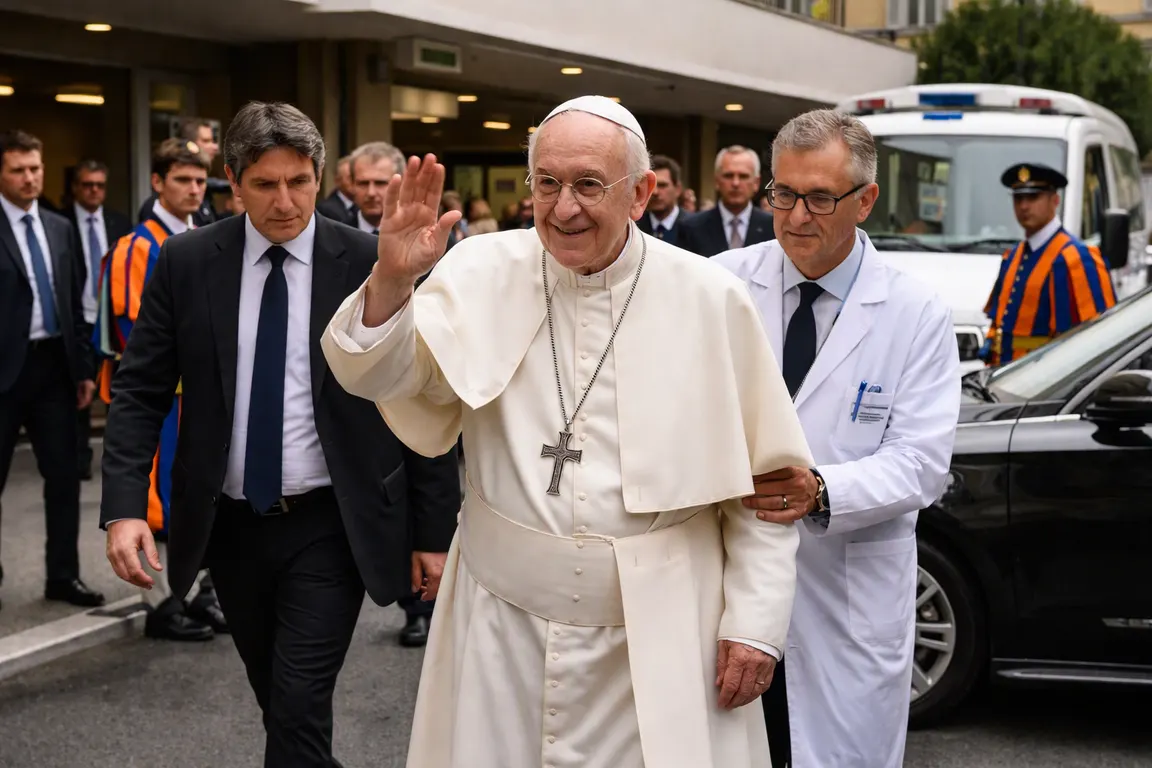
Pope Leo left Rome’s Gemelli Hospital on Saturday, just four days after undergoing a lobectomy to remove a cancerous nodule from his right lung. The rapid discharge comes as the pontiff prepares to begin a month‑long apostolic journey across Latin America on Nov. 6.
The swift clearance has focused attention on how the Vatican evaluates a pontiff’s fitness for duty and what procedures exist if a pope becomes incapacitated. With a schedule that includes twelve commercial flights and two helicopter transfers, the Holy See must balance the pope’s health, the logistics of a high‑profile pilgrimage and the lack of a formal succession protocol.
Surgeons Stefano Margaritora and Luigi Carbone performed the operation on Oct. 22, confirming the tumor as adenocarcinoma, the most common form of lung cancer. Vatican spokesman Matteo Bruni said the pope is “fit for discharge” and able to carry out normal daily activities independently. The pontiff will celebrate the Angelus prayer in St. Peter’s Square on Oct. 27, marking his first public appearance since the surgery.
Oncologists note that patients are typically cleared to fly three weeks after a lobectomy, provided recovery is uncomplicated. The pope’s discharge after just four days is unusually swift, but the Vatican’s medical team has not released the specific criteria used to grant clearance. Detailed pathology reports, including molecular and genetic analysis, are still pending, and any further treatment will depend on those results.
The Latin‑American apostolic journey, scheduled for Nov. 6‑17, will take the pope to several countries with large Catholic populations. The itinerary involves a dozen flights and two helicopter legs to reach remote venues. Vatican staff and security officials are coordinating the complex travel plan while monitoring the pope’s condition, a task complicated by the absence of a codified process for delegating authority should the pope become unable to fulfill his duties.
Canon law does not specify a mechanism for temporary papal incapacity, and the Vatican’s constitution provides only vague guidance on succession. The New York Post highlighted this gap, while other outlets have focused on the pope’s apparent good health. No independent medical verification beyond Vatican statements has been published, leaving observers to rely on official comments for updates.
The pope’s health matters to millions of Catholics, especially in Latin America where the pilgrimage is expected to draw large crowds. If his recovery slows, the Vatican may need to adjust the schedule, limit public liturgies or postpone certain legs of the trip. Media organizations accredited for the journey also depend on timely health briefings to arrange coverage.
After the Angelus on Oct. 27, the pope will continue limited duties while awaiting the final pathology report. Vatican officials have pledged to release further medical information as it becomes available, but they have not outlined a regular reporting cadence. The situation raises a broader question: how will the Holy See handle future health crises of its leader without a clear protocol for temporary incapacity?
As the Latin‑American tour approaches, the Vatican’s handling of Pope Leo’s postoperative care and the transparency of its communication will be closely watched by the faithful and by observers of institutional governance alike.