

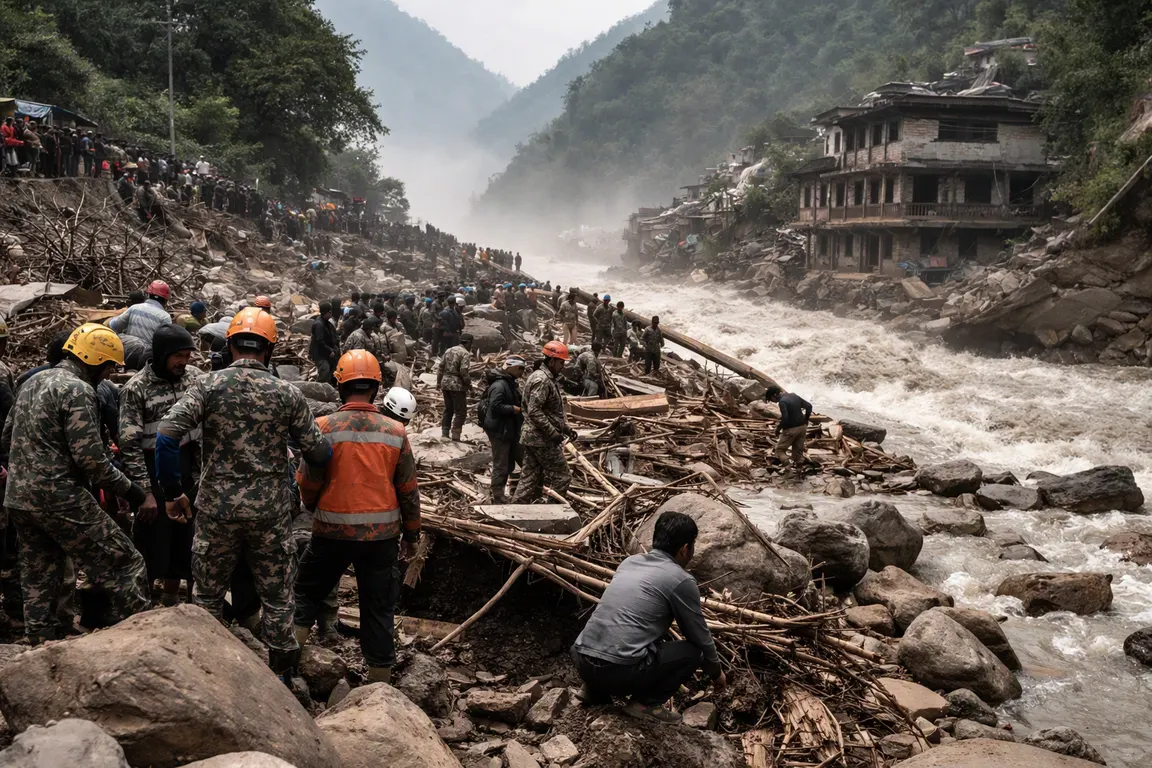
A glacier collapse Nepal flash flood on May 31 sent a nine‑metre‑high torrent down the Trishuli River, killing at least 390 people in Nepal and Tibet and leaving more than 1,400 missing. The event, first mistaken for a magnitude‑4.4 earthquake, was later identified as a magnitude‑5.2 ice‑mass failure that unleashed the flash flood across the border region.
Official counts on June 3 list 389 deaths in Nepal and three in Tibet. Foreign‑national missing figures vary, but the most cited totals include 517 non‑Nepali citizens—among them 178 Indians, 60 Americans and dozens of pilgrims from other countries—reflecting the fluid nature of the search and differing reporting standards.
Infrastructure damage is extensive. More than 35 bridges have been swept away, roughly 40 km of road are unusable, and a hydropower tunnel now holds about 100 workers trapped inside. A newly formed glacial lake at the collapse site holds an estimated two million cubic metres of water; engineers warn that overtopping could trigger a downstream dam‑burst flood, threatening additional villages and rescue operations.
Rescue efforts are led by the Nepalese army, which has air‑lifted over 100 survivors and deployed more than 30,000 security personnel along the valleys. On the Tibetan side, about 500 Chinese military and paramilitary personnel have been mobilised, and Premier Li Qiang arrived in Gyirong on June 3 to oversee the response.
International aid pledges total $229 million, including A$5 million (US$3.6 million) from Australia, US$2 million from the United Nations and US$1 million from Switzerland. The World Bank, India, China and the United States have also committed funds for emergency relief and reconstruction.
Climate experts link the growing frequency of glacier‑related floods to rising temperatures in the Himalayas. A similar flash flood struck the same watershed in August 2025, underscoring a pattern of melt‑induced hazards. While the immediate trigger was a sudden ice‑mass collapse, accelerated melt due to climate change raises the probability of future lake formation and outburst events.
The disaster has immediate economic repercussions. The loss of bridges and roads halts trade across the Nepal‑China border, tourism revenue has collapsed as pilgrimages to Mount Kailash are suspended, and the delayed hydropower project threatens energy supplies for both countries. About 1,200 residents from three villages have been displaced and are sheltering in temporary camps.
Authorities are monitoring lake levels around the clock and have installed early‑warning sensors to alert downstream communities of any rapid rise. Search teams continue to comb the riverbanks and the collapsed tunnel, while diplomatic channels press for updates on missing nationals. The next critical step will be a coordinated decision on whether to drain the glacial lake pre‑emptively, a move that will require joint technical assessment by Nepalese, Chinese and international engineers.