

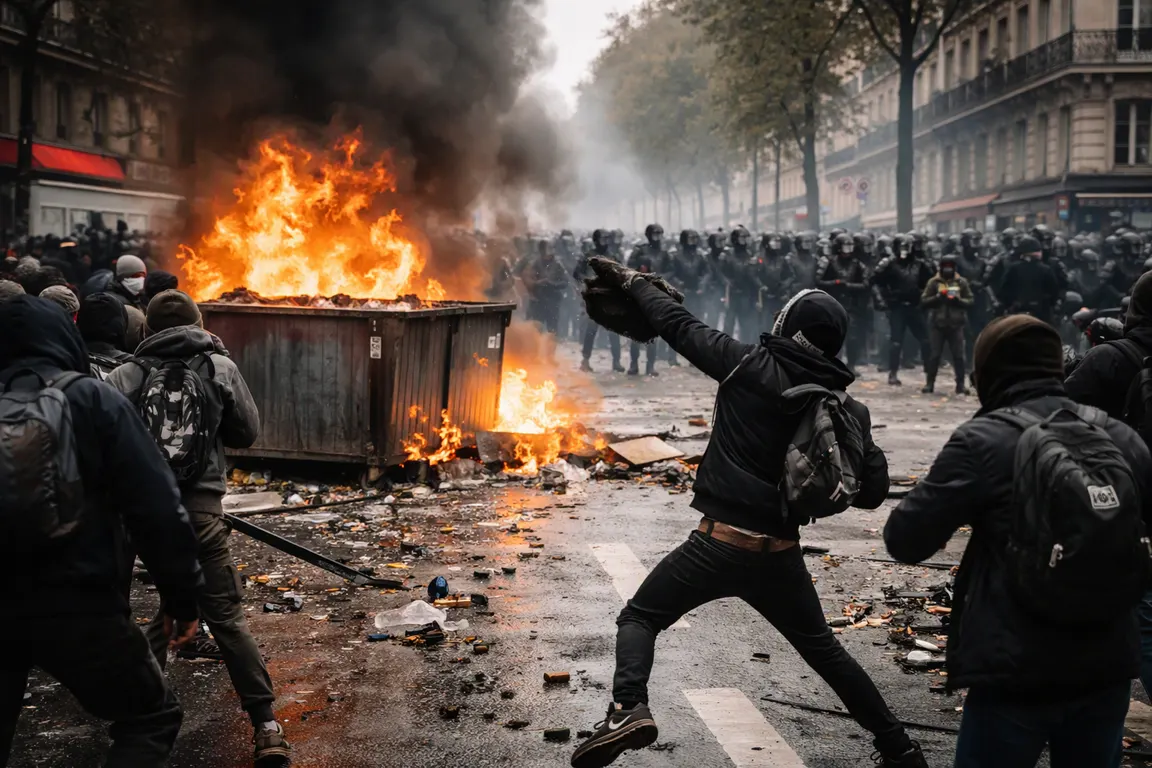
Hundreds of thousands of demonstrators took to the streets in cities across France on Saturday to protest soaring living costs, cuts to student allowances and broader fiscal tightening. The French cost-of-living protests began as largely peaceful rallies but turned violent, with fires, looting and more than 1,000 people taken into police custody.
Early Saturday, crowds gathered in Paris, Marseille, Lyon and smaller towns. Organisers said the protests were a response to recent hikes in school fees and the rising price of basic goods, a sentiment echoed by participants interviewed by The Independent.
In Paris, police deployed tear‑gas after a minority of protesters tried to breach a police line near Place de la République. In Marseille, officers confronted a group attempting to storm the town hall and used similar crowd‑control measures. The Guardian reported that more than 400 arrests were made in the two cities combined.
As the afternoon progressed, isolated incidents of arson spread through city centres. Demonstrators set cars ablaze on Rue de Rivoli in Paris and ignited a storefront in Marseille’s Vieux Port district. The Wall Street Journal and BBC confirmed that multiple buildings were damaged by fire and that looting occurred in several commercial areas.
By nightfall, police had detained over 1,000 individuals nationwide, according to the BBC. The tally includes arrests in smaller municipalities where clashes were less visible but still resulted in property damage. Authorities said most detainees face charges of vandalism, unlawful assembly and arson.
Government officials attributed the escalation to “ultra‑left” agitators, a claim noted by The Guardian but not corroborated by other outlets. The Ministry of the Interior declined to name specific groups, emphasizing the need to restore order and protect citizens.
The unrest poses immediate public‑safety risks. Residents in affected neighbourhoods faced uncontrolled fires and confrontations with police, while local businesses reported inventory losses and structural damage. Police resources were stretched, limiting response capacity to other incidents.
Economically, the disruptions could reverberate beyond the protest zones. Retail sales in the affected districts are expected to dip in the short term, and tourism operators in Paris and Marseille warn of potential cancellations as headlines focus on unrest rather than cultural attractions.
Analysts note that the scale of participation—more than half a million people, per the BBC—signals deep‑seated discontent with fiscal policy. Yet no clear governmental response has been outlined, leaving the policy implications uncertain.
The episode raises questions about the durability of the unrest. If economic pressures persist, similar demonstrations could surface in other European capitals where cost‑of‑living concerns are mounting. Observers caution that without targeted policy measures, the risk of repeat flashpoints remains.
French authorities say they will review police deployment strategies and consider additional support for affected businesses. Legal proceedings against the detained protesters are expected to proceed, leaving the broader societal impact unresolved.