

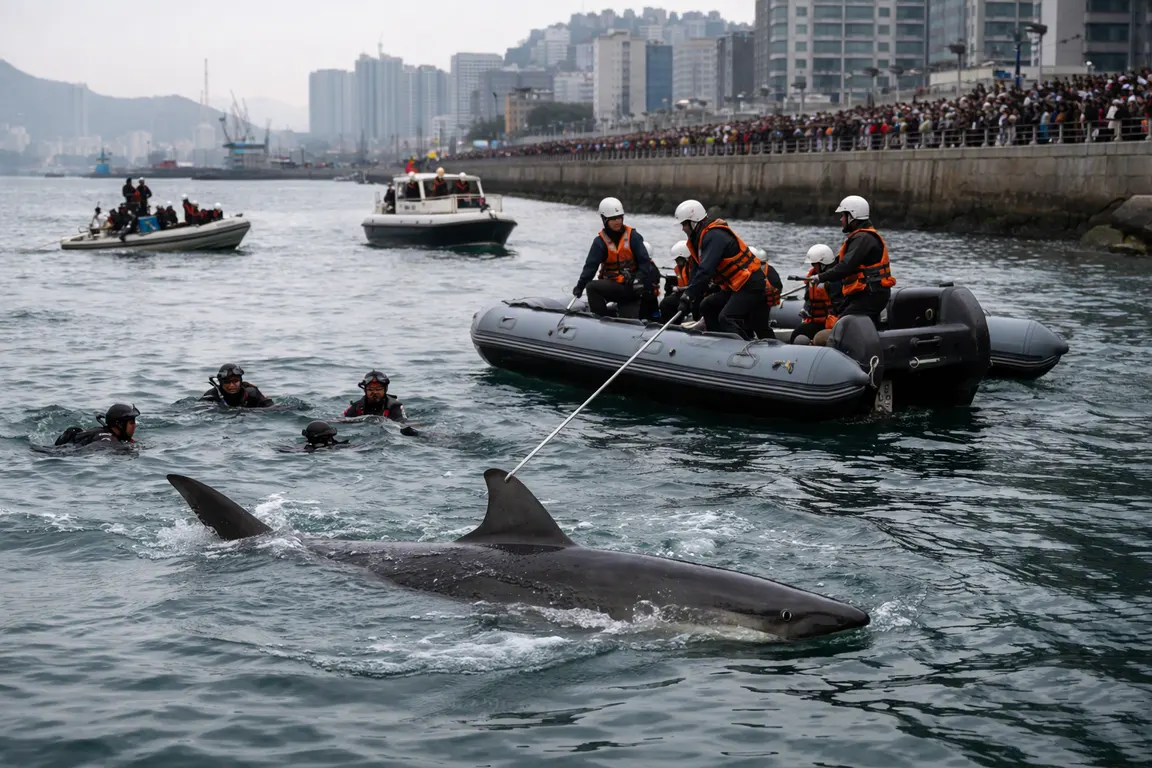
A three‑metre female dusky shark, nicknamed Bukangi, was finally escorted out of Busan’s North Port canal on Wednesday, ending a month‑long rescue that drew more than 1.6 million on‑site visitors.
The shark first entered the artificial waterway in mid‑September 2023. City officials responded on 29 September with high‑pressure water jets to push the animal toward the canal mouth, but the shark remained lodged. A second effort on 2 October used static nets, which also failed. The successful third operation combined a floating platform, a crew of rowers and a movable net that guided the shark toward open water. Mayor Chun Jae‑soo called the animal a “city mascot” on Facebook and thanked volunteers and the public for their patience.
The episode quickly became a tourist magnet. Local vendors reported a surge in sales as crowds swelled along the canal, with foot‑traffic estimates ranging from 1.6 million to 1.7 million people over the month‑long stay. A live‑stream of the shark attracted thousands of online viewers, extending the spectacle beyond the city’s borders. The tourism office noted the exposure could translate into longer‑term visitor growth, though the exact economic impact remains unquantified.
Marine biologists monitoring the shark said it showed no signs of feeding and appeared stressed by the sudden drop in water temperature as autumn set in. “Dusky sharks are typically found in deeper, cooler waters,” said Dr. Lee Hyun‑woo of Busan National University. “When surface temperatures fall, a large individual can become disoriented, especially in a confined channel.” Environmental NGOs linked the shark’s presence to broader climate‑driven shifts, arguing that warming seas are pushing subtropical species farther north.
The incident also highlighted tensions between public safety, economic interests and ecological stewardship. Some residents complained about congestion and temporary road closures along the canal, while others welcomed the attention the shark brought to the area. Emergency services treated the rescue as a public‑safety operation, yet the massive visitor turnout turned the effort into a de‑facto tourism event.
Experts caution that the shark’s brief appearance should not be taken as a definitive indicator of ecosystem health, but it underscores the need for adaptive policies. “We need systematic monitoring of marine species that venture into urban waterways,” said Kim Soo‑jin, director of the Korean Marine Conservation Alliance. “If climate change continues to alter species distributions, cities must be prepared for similar encounters.”
Busan officials have not announced specific new guidelines, but the mayor’s office indicated a review of emergency‑response protocols for wildlife incidents is underway. The review will consider how to balance rapid rescue actions with crowd management and environmental messaging.
As the shark disappeared into the open sea, the city was left with a mixed legacy: a successful rescue that boosted local commerce, a reminder of the region’s vulnerability to shifting marine patterns, and an unresolved question about how urban authorities will handle future wildlife surprises.