

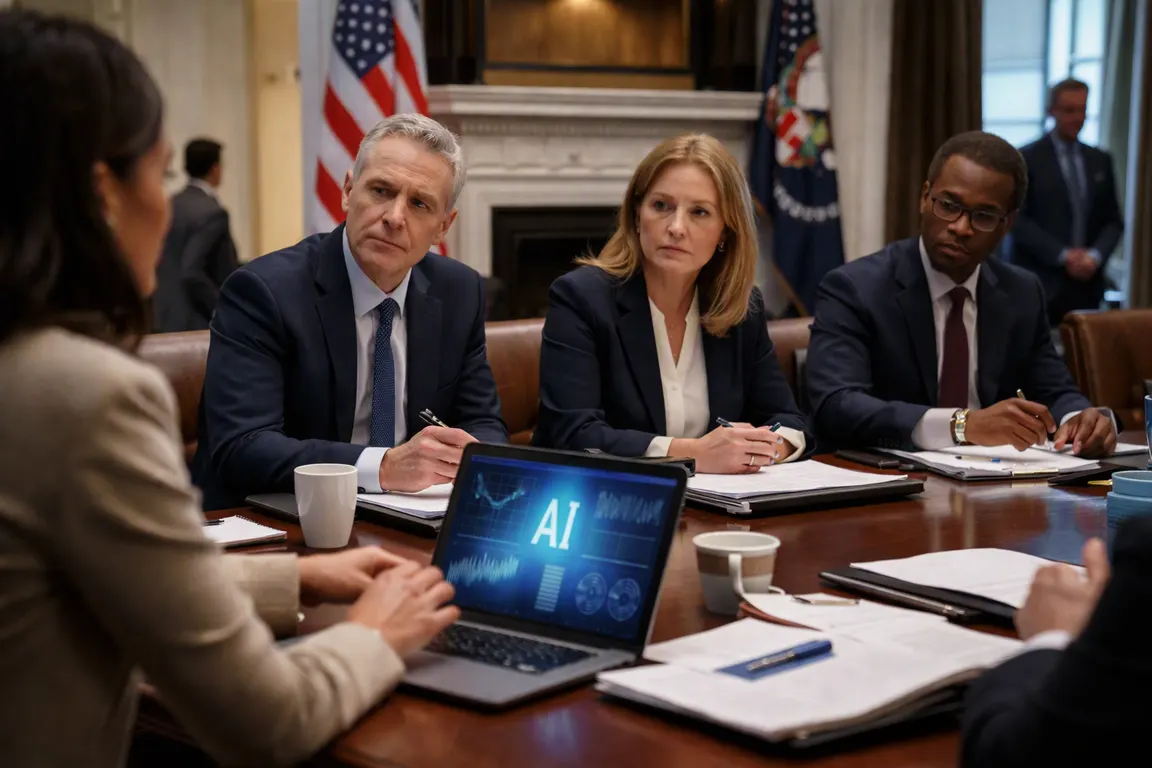
White House officials are quietly preparing a set of limited AI safeguards, even as President Donald Trump has dismissed calls for AI regulation as a “hoax” and a “sick conspiracy.” The contrast between the president’s public dismissal and the internal policy work underscores uncertainty about how the United States will manage increasingly powerful AI systems.
According to multiple reports, Trump argued that a “strong and smart president” is the only guardrail needed to keep AI in check. At the same time, senior staff in the Executive Office have been tasked with drafting modest safety measures aimed at preventing catastrophic outcomes. No details of the draft have been released, and no formal executive order or legislation on AI has been announced.
The gap matters for three reasons. First, unchecked AI poses direct public‑safety risks, from the spread of disinformation to failures in autonomous technologies. Second, the tech sector is watching the policy environment closely; uncertainty about future rules can shape investment decisions, research priorities and the competitive posture of U.S. firms. Third, policymakers in Washington and abroad are weighing the strategic implications of a lax regulatory stance. Some analysts warn that over‑regulation could hand a competitive advantage to China, while under‑regulation might erode confidence in U.S. leadership on emerging technology.
The New York Post cited an “On The Money” source who said the internal effort is a response to concerns that AI could trigger “mass‑extinction” scenarios. The source described the draft as focusing on “limited safeguards,” implying measures short of broad legislative frameworks. The Independent World and NBC News also reported the president’s social‑media posts downplaying the need for AI guardrails, reinforcing the public narrative that regulation is unnecessary.
Sources close to the White House say the draft safeguards are intended to address existential‑risk concerns without stifling innovation. However, the lack of detail leaves open questions about scope, timing and enforceability. Critics argue that without clear parameters any safeguards could be symbolic rather than substantive. Proponents within the administration warn that premature or heavy‑handed regulation could slow U.S. AI development and cede ground to foreign competitors, particularly China, which is advancing its own AI governance frameworks.
Industry observers note that policy ambiguity is already influencing corporate behavior. Some firms are voluntarily adopting internal safety protocols, while others are lobbying for clearer guidance. Congressional committees have begun holding hearings on AI risk, but no bills have advanced, in part because the president’s stance has downplayed the urgency of legislative action.
The next steps remain unclear. The White House is expected to circulate the draft safeguards among senior officials for review, and advisers may present a proposal to the president in the coming weeks. Congress is likely to monitor the internal effort and could craft its own response if the executive branch does not move forward. Until a concrete policy emerges, the United States faces a potential mismatch between public rhetoric and behind‑the‑scenes preparation, a dynamic that could shape the safety, competitiveness and global standing of its AI ecosystem.