

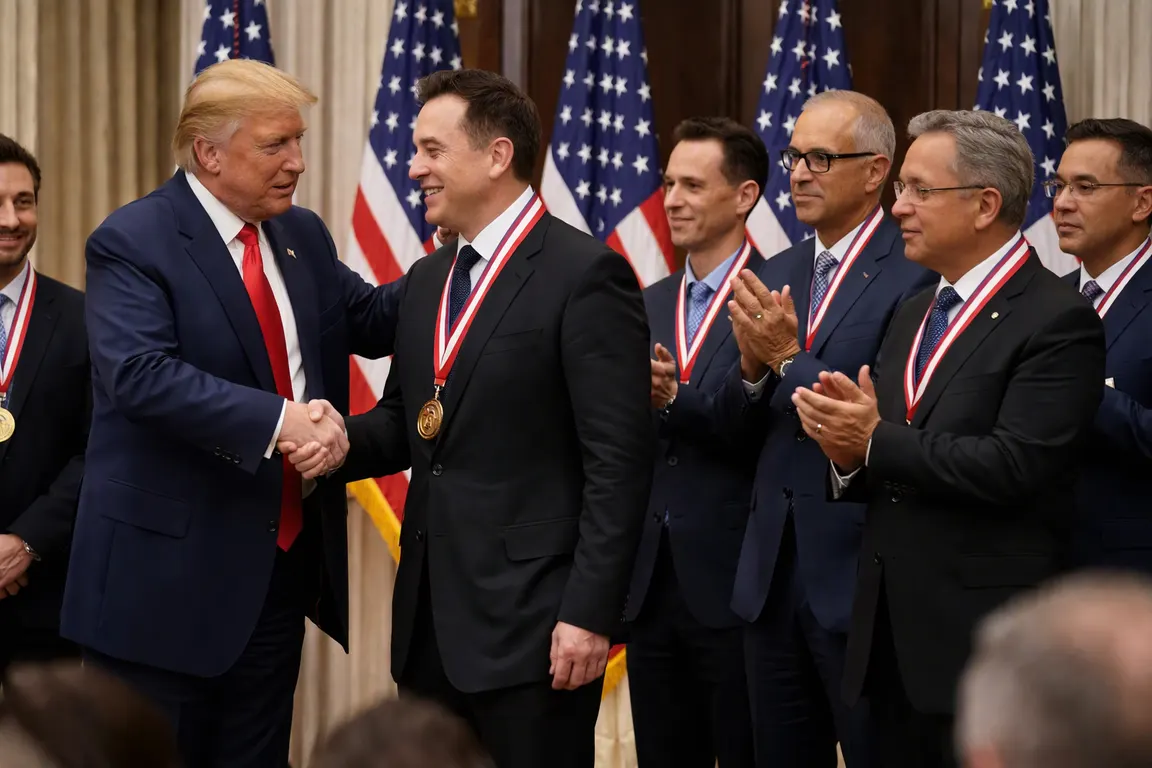
President Donald Trump presented the Trump science awards — the National Medal of Science to Elon Musk, Sergey Brin, Jensen Huang and Lisa Su, and the National Medal of Technology and Innovation to Michael Dell and Satya Nadella — at a ceremony on Thursday at the Washington Peace Institute. The event, billed as the summit “Science: A New Golden Age,” was framed as a public‑private partnership showcasing the administration’s science agenda.
By honoring executives who dominate artificial‑intelligence, semiconductor and aerospace markets, the White House linked its priorities to firms that form the nation’s strategic technology base. Observers see the ceremony as a signal to investors, policymakers and researchers that federal funding, regulatory approaches to AI and defense contracts may increasingly align with the commercial interests of these companies.
The awards marked the first time the Trump administration combined the two highest civilian science honors in a single, highly publicized event. Trump called Musk a “national treasure” and likened him to Thomas Edison. He also presented a posthumous National Medal of Science to John Trump, his late uncle and former MIT professor.
The timing follows a turbulent year for Musk and the administration. After a brief stint at the Department of Government Efficiency ended in a public dispute in May 2025, Musk re‑engaged with the White House, attending a state dinner for Chinese President Xi Jinping in September 2025 and joining AI talks the week before the awards. Those meetings, also under the “Science: A New Golden Age” banner, suggest a deliberate effort to bring industry leaders into policy discussions on emerging technologies.
Industry analysts say the medals could boost the laureates’ credibility with federal agencies, potentially easing access to contracts in AI research, advanced chip manufacturing and space‑defense projects. Critics note that the honors do not guarantee policy change and warn that the scientific community may feel pressure to align with the administration’s self‑regulation stance on AI.
The ceremony also raised questions about how the government will balance public‑private collaboration with oversight. While no new funding initiatives tied directly to the medals have been announced, the symbolic endorsement could influence upcoming budget proposals for the Department of Energy, the National Science Foundation and the Defense Advanced Research Projects Agency. Whether those proposals will translate into preferential treatment for the honored firms remains uncertain.
As the White House prepares its fiscal‑year budget, analysts will watch for any legislative or regulatory language that references the medal recipients or the “golden age” agenda. Until such measures are disclosed, the awards stand as a high‑profile gesture signaling a strategic alignment, but the extent to which they will reshape America’s AI and space‑defense priorities is still an open question.