

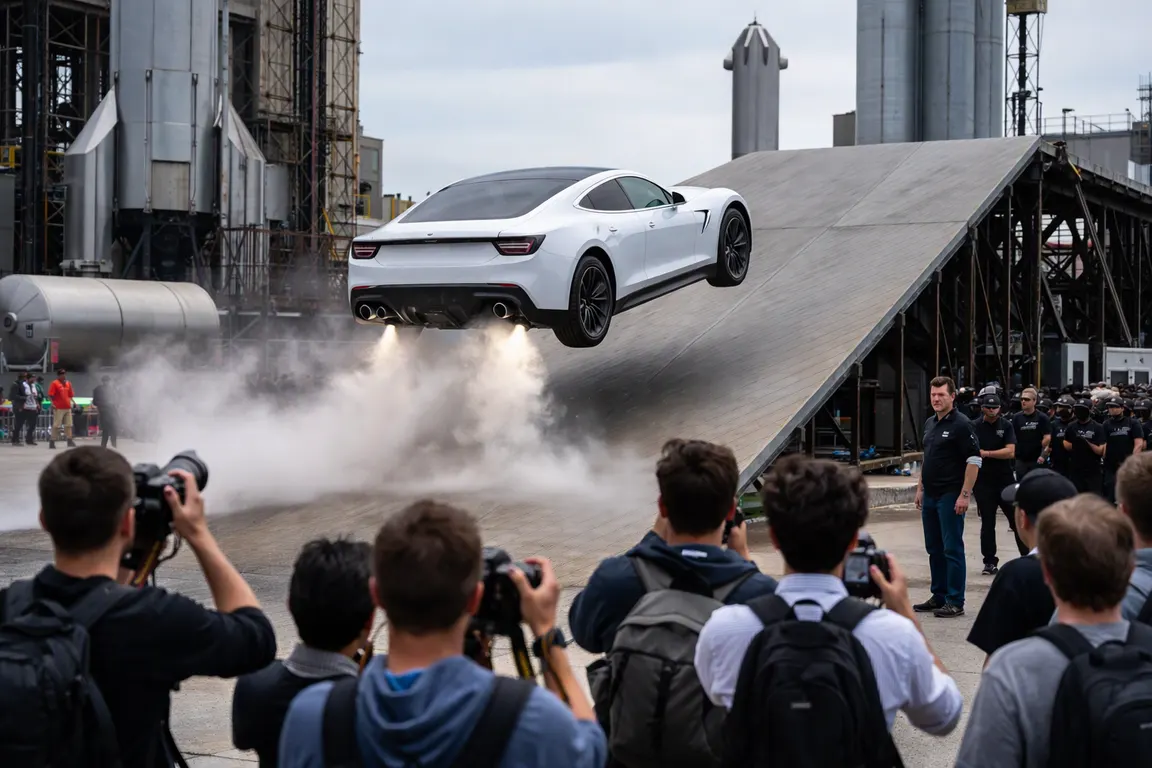
Tesla demonstrated a prototype Roadster equipped with high‑pressure air‑thruster tanks at SpaceX’s Houston test facility on Thursday. The Tesla Roadster thruster demo saw the vehicle accelerate up a steep ramp, briefly hover, and land on its wheels while Elon Musk announced a target for production start in 2028. The spectacle shifted focus from the launch itself to the policy, safety and infrastructure challenges such a vehicle would create.
The demonstration marked the first public display of an electric car that can leave the ground on command. By pairing conventional drivetrain components with rocket‑thruster pods, Tesla claims the Roadster can reach 60 mph in under a second and perform a controlled jump, even driving upside‑down during the maneuver. The event was streamed on Tesla’s X account and covered by several news outlets, each highlighting different aspects of the claim.
If the prototype moves beyond the testing phase, existing road‑traffic statutes, air‑space regulations and insurance frameworks will need rapid adaptation. Federal agencies such as the Federal Aviation Administration and the National Highway Traffic Safety Administration have not yet approved any “flying” capability for a consumer‑grade automobile, and officials have described the technical and regulatory hurdles as significant. Municipalities may also have to consider reinforced road surfaces, dedicated landing zones and new signage to accommodate vehicles that can launch into the air and return to the pavement.
The concept builds on a century‑old lineage that began with early flying‑car experiments, but modern electric motors and battery technology have revived interest. Tesla’s partnership with SpaceX provides the rocket‑thruster expertise that differentiates this effort from earlier attempts. However, the performance metrics presented—speed, launch angle and brief hover—remain unverified by independent testing, and the altitude or duration of flight was not disclosed.
Stakeholders face a range of uncertainties. Early adopters could encounter higher insurance premiums or new liability clauses as insurers grapple with risk assessments for mixed‑mode vehicles. Regulators will likely need to draft rules that define when a vehicle is considered an aircraft versus a road vehicle, how flight paths intersect with existing air‑traffic corridors, and what certification standards apply to the thruster system. Urban planners may be pressed to allocate space for take‑off ramps and landing pads, potentially reshaping streetscapes in dense areas.
Automotive and aerospace suppliers stand to benefit from a market that blurs traditional sector boundaries, while competitors may accelerate their own research into airborne mobility. Yet the projected 2028 production timeline appears optimistic given the admitted technical challenges and the absence of any regulatory green light. Industry analysts caution that certification processes for a vehicle that can both drive upside‑down and launch into the sky could take several years, especially if safety testing uncovers unforeseen failure modes.
The next concrete step will be Tesla’s filing of formal requests with the FAA and NHTSA for test‑flight and road‑use approvals. Those applications will likely trigger public comment periods and inter‑agency coordination, setting the pace for when, if ever, a “flying” Roadster could appear on public streets. Until such clearances are granted, the road to 2028 remains contingent on resolving safety standards, air‑space rules and infrastructure investments highlighted by Thursday’s demonstration.