

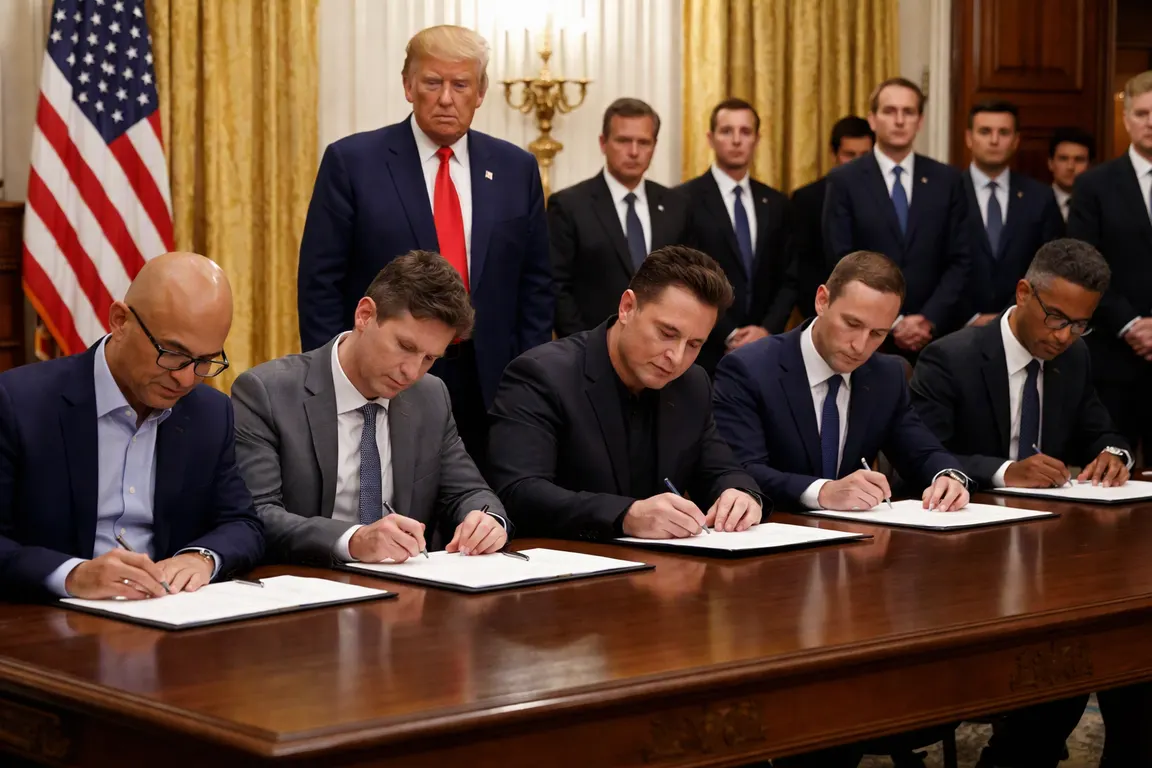
Former President Donald Trump convened a White House summit of leading technology executives, during which the participants signed a voluntary AI safeguards pact. The agreement, described by the firms as “robust,” contains no legally binding provisions, disclosed technical standards, or formal enforcement mechanism.
The pact arrives as governments and international bodies intensify calls for formal AI governance. With AI tools increasingly deployed in finance, health care and critical infrastructure, the lack of a statutory framework raises questions about how the United States will protect public safety while relying on industry goodwill.
Trump framed the initiative as a preview of what is possible with “super intelligence,” emphasizing self‑regulation over legislative action. Coverage by RealClearPolitics portrayed the summit as a triumph of innovation, while The Independent noted that Americans were told they had “no choice” but to trust the tech firms.
The signatories included CEOs from several major firms, though reports did not list every company or the exact language of the agreement. Sources such as Al Jazeera and NBC confirmed that the leaders pledged to adopt safeguards, but they also noted that the pact lacks specific timelines, monitoring bodies or penalties for non‑compliance. Without a statutory anchor, the agreement relies on each company’s internal risk‑assessment processes and the goodwill of its leadership.
Industry observers see two possible outcomes. First, the participating firms may set informal best‑practice standards that ripple through the sector, influencing product development cycles and risk‑management protocols. Second, competitors outside the pact could feel pressure to adopt similar measures or risk attracting regulatory scrutiny as lawmakers consider more formal rules.
Internationally, the United States’ voluntary approach contrasts with emerging frameworks in the European Union and multilateral discussions at the OECD, which are moving toward binding requirements for transparency, data governance and accountability. Analysts note that the U.S. pledge does not address how it aligns—or conflicts—with those efforts, leaving a gap in cross‑border coordination.
Critics point out that without defined technical standards or an independent audit mechanism, the pact may not prevent harmful deployments, such as biased decision‑making tools in lending or untested medical algorithms. If voluntary compliance falters, the gap could prompt Congress to intervene with legislation, echoing earlier calls for statutory AI oversight.
Policymakers and regulators now face a practical dilemma: assess whether industry self‑regulation can deliver measurable safety benefits, or pursue statutory authority that would impose enforceable standards. The White House has not indicated a timeline for any follow‑up reporting or verification of the companies’ progress.
As the debate over AI governance sharpens, the next step will likely be a congressional hearing or an executive directive that clarifies the role of voluntary pledges within a broader regulatory strategy. Until then, the effectiveness of the White House‑led pact remains an open question, and its impact on public safety, market behavior and future policy will be closely watched by both industry and regulators.