

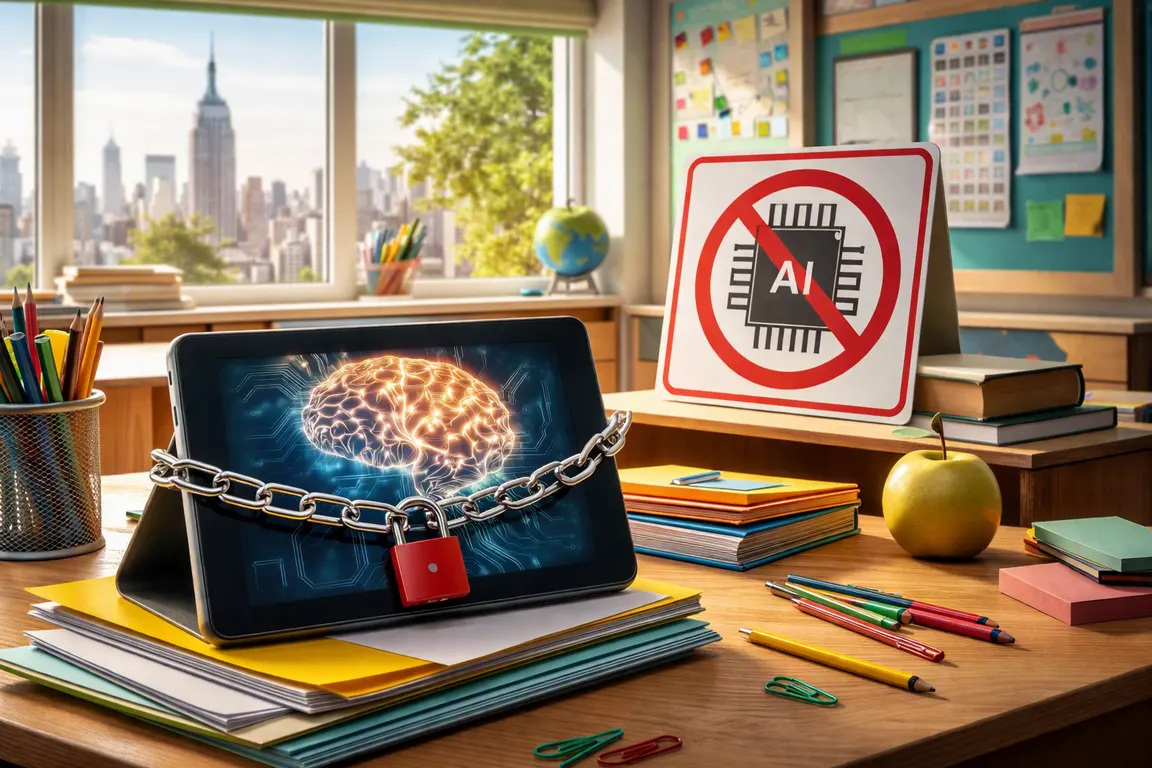
New York City will prohibit the use of generative‑AI tools in public pre‑K through eighth‑grade classrooms beginning Sept. 2, 2026. The one‑year moratorium, announced by Mayor Zohran Mamdani, affects roughly 600,000 students for the 2026‑27 school year while high‑school pilots continue under strict limits.
The ban matters because the NYC Department of Education is the nation’s largest public‑school system. State officials and districts elsewhere are watching the rollout as a possible model. Governor Kathy Hochul praised the move as a child‑safety measure, and Assembly members Bobby Carroll and Jo Anne Simon are drafting legislation that could extend similar limits statewide.
Under the policy, student‑facing AI tools are barred in pre‑K‑8 grades, but teachers may still use AI for lesson planning, grading and administrative tasks. High‑school students may access AI only through limited pilot programs and must complete two 45‑minute AI‑awareness courses each year. Exemptions exist for students with disabilities or limited English proficiency; the city cites eye‑tracking software for cerebral palsy and language‑interpretation apps as permissible tools.
A task force of students, educators, parents, city officials and industry experts will monitor the ban’s impact and issue a report after the school year. The decision follows a March 2026 framework that had allowed limited student use of AI but was tightened amid concerns about unfiltered content, data privacy and equity.
The ban removes a growing class of digital assistants that many districts have adopted for reading support, math practice and research. Advocates warn the restriction could widen the digital‑tool gap between NYC learners and peers in states without similar limits. Teachers will need to redesign lessons that previously relied on AI‑generated prompts or feedback, potentially increasing preparation time even as they retain AI for behind‑the‑scenes work. Ed‑tech vendors face an immediate revenue hit as 38 AI‑enabled products lose access to the city’s largest market, prompting some to consider redesigns that comply with the new rules.
The task force will evaluate the moratorium using metrics such as student engagement, achievement gaps, teacher workload and the effectiveness of accommodations for special‑needs students. Its findings will guide whether the city lifts the ban, extends it or modifies the high‑school pilot.
Classrooms reopen on Sept. 10 under the new restrictions. The experiment will test whether a broad AI ban improves safety and equity or whether a more calibrated approach is needed, and its results are already shaping legislative proposals across the state and nation.