

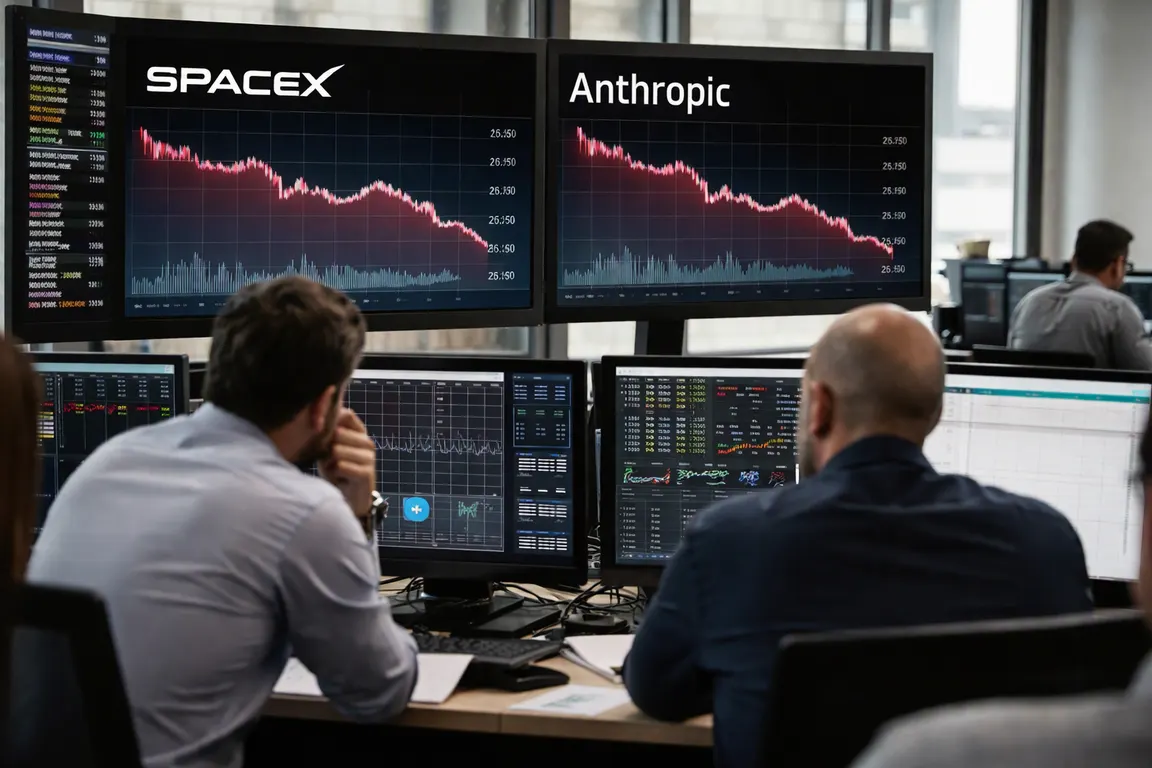
SpaceX’s October earnings disclosed a $20 billion AI‑compute capital plan and a bond price slump to 83.3 cents, while Anthropic’s updated S‑1 revealed an $80.7 billion half‑year loss and more than $600 billion of take‑or‑pay compute contracts. Both firms now carry non‑cancelable liabilities that could reshape financing for frontier AI and test credit markets, highlighting a rising AI compute risk.
SpaceX reported Q3 2026 revenue of $14.58 billion and adjusted EBITDA of $8.81 billion, beating analysts’ forecasts. The company announced a $20 billion capex program to lift installed AI compute to 1.7 GW, short of the 1.74 GW consensus. Its 6.65% notes due 2056 fell to a lifetime low of 83.3 cents, and the five‑year credit‑default swap spread widened to roughly 198 basis points. Deutsche Bank projects 2027 revenue of $125 billion and EBITDA of $84 billion, but estimates that more than $200 billion of additional capex will be required to reach the 2‑5 GW compute target the firm has set for the next year. To fund the rollout, SpaceX is seeking a $40 billion financing package on top of the $65 billion already borrowed since June.
Anthropic’s S‑1 for the first half of 2026 shows $16.3 billion in revenue but a GAAP net loss of $80.7 billion, of which $72 billion is a non‑cash accounting charge tied to massive compute commitments. The company has signed take‑or‑pay contracts obligating it to purchase $600 billion to $750 billion of AI‑compute capacity, with an additional $150 billion under negotiation. Roughly 20 percent of its H1 2026 revenue comes from just two customers, highlighting a concentration risk that could jeopardize its ability to meet those obligations if either client reduces spend.
The parallel trajectories of the two firms illustrate a shift in AI economics: infrastructure costs are moving from variable operating expenses to fixed, long‑term liabilities. For investors, the immediate signal is the widening gap between projected cash flow and the debt service required to honor compute contracts. SpaceX’s bond market reaction – a historic price dip and rising CDS spreads – shows that credit analysts view the debt as increasingly risky. Anthropic’s reliance on a narrow customer base compounds that risk; any contraction in those contracts would leave the company with a massive unutilized compute commitment and limited revenue to offset it.
If the projected 2027 revenue growth materializes, it may narrow the financing gap, but the margin remains thin. A slowdown in AI demand, tighter credit conditions, or a shift in customer spending could force either company to renegotiate contracts, raise additional capital at higher cost, or, in a worst‑case scenario, default on debt. Such outcomes would likely reverberate through the broader tech credit market, raising borrowing costs for other firms that depend on similar compute infrastructure.
Regulators and policymakers are watching these developments. Potential actions include greater disclosure requirements for non‑cancelable compute contracts, stress‑testing of AI‑focused credit exposures, and guidance on capital adequacy for firms with outsized fixed‑cost obligations. Until such measures are in place, investors will need to monitor bond spreads, financing negotiations and customer concentration metrics closely, as the hidden debt mountain beneath the AI hype could become a catalyst for broader market instability.