

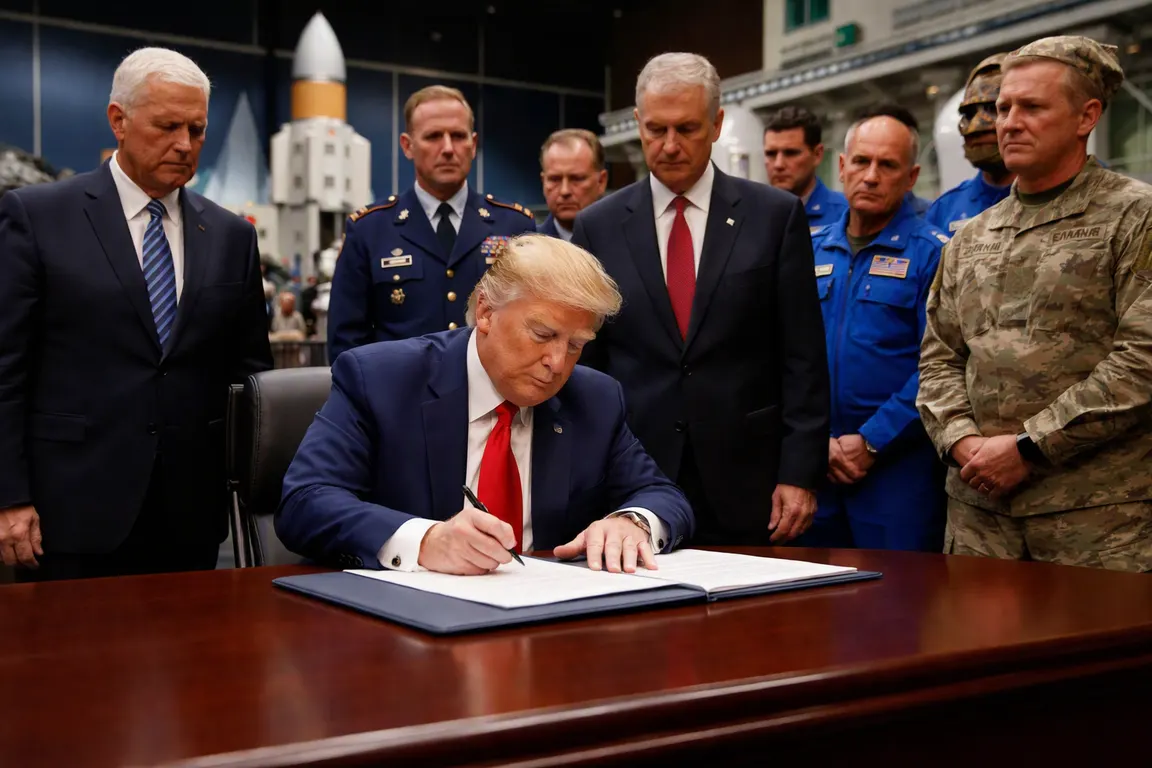
WASHINGTON — The Trump administration issued an executive order Friday establishing a U.S. Space Academy, a joint training institution for the Space Force, NASA and the commercial space sector. The order was signed at NASA’s Johnson Space Center, marking the first formal step toward a centralized pipeline for space‑related education and skill development.
President Donald Trump announced the order during a ceremony at the center, where he also presented the Congressional Space Medal of Honor to the crew of NASA’s Artemis 2 mission. He linked the academy to recent Space Force operations, emphasizing the service’s expanding role in national security.
The academy will be modeled after the U.S. Military Academy at West Point and is intended to standardize core competencies such as orbital mechanics, space systems engineering and operational tactics. Separate tracks will address defense, research and commercial launch operations, aiming to improve interoperability among the Space Force, NASA and private launch providers.
Proponents say a unified training hub could streamline talent development, giving enlisted personnel, civilian engineers and other candidates a clear career path that bridges military duties and commercial opportunities. Defense contractors and launch companies would gain a pipeline of graduates versed in both military doctrine and commercial best practices, supporting U.S. goals for lunar and deep‑space missions.
Critics note the order’s lack of detail on funding, location and enrollment criteria. They warn that without transparent resources the academy could divert talent from existing university programs and that coordination among the Department of Defense, NASA and industry will be essential but challenging.
The executive order does not specify a campus, budget or timeline for the first class. An interagency task force has been tasked with developing the curriculum, selecting a site and seeking congressional appropriations. Until those details are released, prospective applicants have no clear roadmap.
The academy arrives as the United States seeks to outpace China’s rapidly expanding space capabilities and to meet its goal of landing astronauts on the Moon before 2030. By institutionalizing space training, the administration signals a long‑term commitment to maintaining a competitive edge in the contested domain of outer space.
Observers will watch how the academy’s design addresses the practical needs of a multidisciplinary space workforce and whether it can deliver the promised efficiencies and talent pipeline without compromising existing academic programs.
The next steps involve finalizing the curriculum, securing a campus and obtaining appropriations from Congress. If implemented effectively, the Space Academy could become a cornerstone of America’s strategic posture in space.