

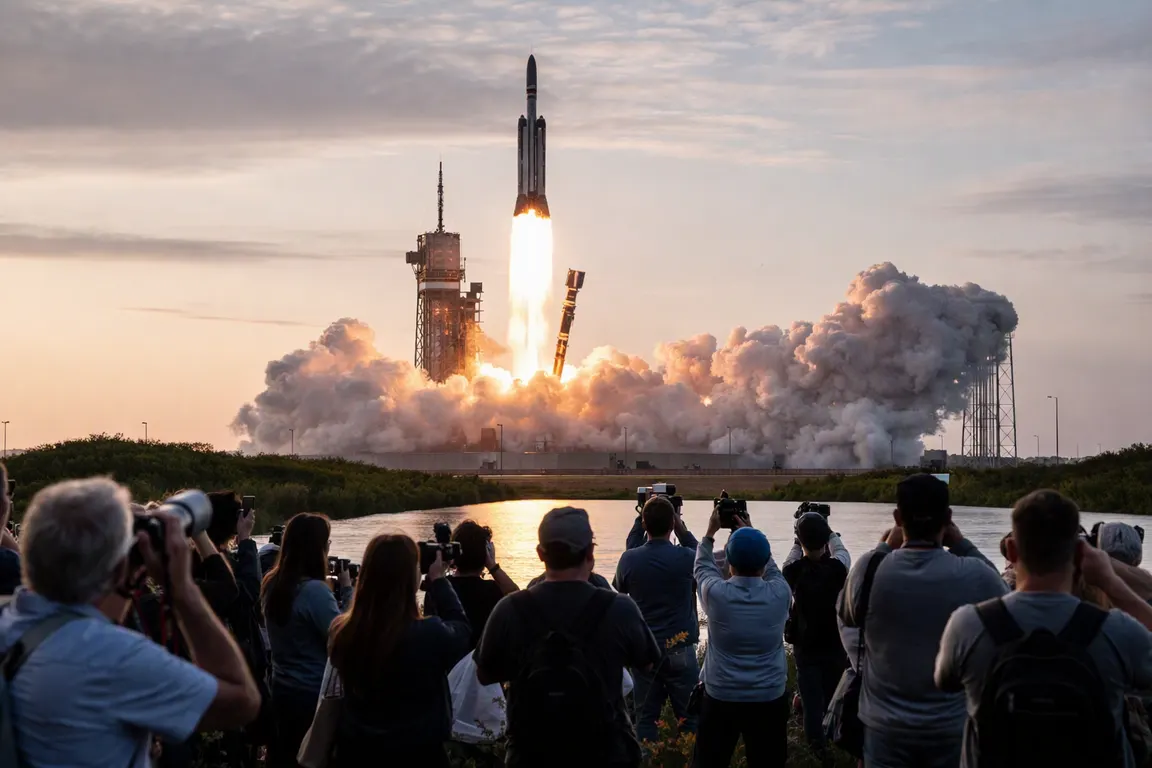
A SpaceX Falcon Heavy lifted off from Kennedy Space Center at 7:26 a.m. EDT Sunday, delivering NASA’s Nancy Grace Roman Space Telescope into a 1.5‑million‑kilometre orbit. This Roman Space Telescope launch, the first Falcon Heavy mission dedicated solely to a science payload, begins a multi‑year survey that will map the universe with a field of view more than 100 times larger than Hubble’s.
The timing is notable for astronomers wrestling with a discrepancy between early‑universe measurements of the cosmic expansion rate and those derived from nearby supernovae. Roman’s ultra‑wide infrared camera will produce a high‑precision map of dark‑energy‑driven acceleration, while its experimental coronagraph will directly image exoplanets by blocking starlight.
Roman carries a 2.4‑metre primary mirror identical to Hubble’s, but its Wide‑Field Instrument can capture an area equivalent to over 100 Hubble pointings in a single exposure. That efficiency enables observations of billions of galaxies, tens of thousands of supernovae and thousands of exoplanet candidates far faster than earlier missions. By contrast, the James Webb Space Telescope, optimized for deep, narrow observations, cannot match Roman’s survey speed.
The mission’s three flagship investigations are the High‑Latitude Survey, which will chart large‑scale structure to tighten dark‑energy constraints; the Supernova Survey, which will amass a homogeneous sample of distant exploding stars to address the Hubble‑constant tension; and the Exoplanet Microlensing Survey, which will monitor the Galactic bulge to detect planets as small as Mars.
Delivering roughly 1.3 terabytes of raw data each day required a new cloud‑based architecture. NASA’s system ingests telemetry, runs calibrated pipelines and releases products to the public within days. The open‑access model lets university researchers, commercial cloud providers and citizen scientists work with the data without a proprietary period. Early demand for high‑performance computing has prompted partnerships with Amazon Web Services and Google Cloud to expand storage and processing capacity.
Politically, Roman survived two proposed budget cuts during the Trump administration and secured its full $4.3 billion budget, reflecting bipartisan support for large‑scale space science. The telescope is named after Nancy Grace Roman, NASA’s first chief astronomer, marking the first time a NASA mission has been named for a woman.
Roman will separate from its upper stage about 30 minutes after launch, and the side boosters landed safely on the Atlantic shoreline. The observatory is expected to reach its operational orbit roughly 100 days later and begin science observations in early 2028, with the first data releases slated for later that year. Coordinated analyses are planned with ESA’s Euclid mission, the Vera C. Rubin Observatory and the James Webb Space Telescope.
The launch adds a powerful, publicly available dataset to the global astronomy toolkit. As the mission ramps up, scientists and policymakers will need to sustain the computational infrastructure required to turn terabytes of nightly data into new insights about the universe’s most elusive components.