

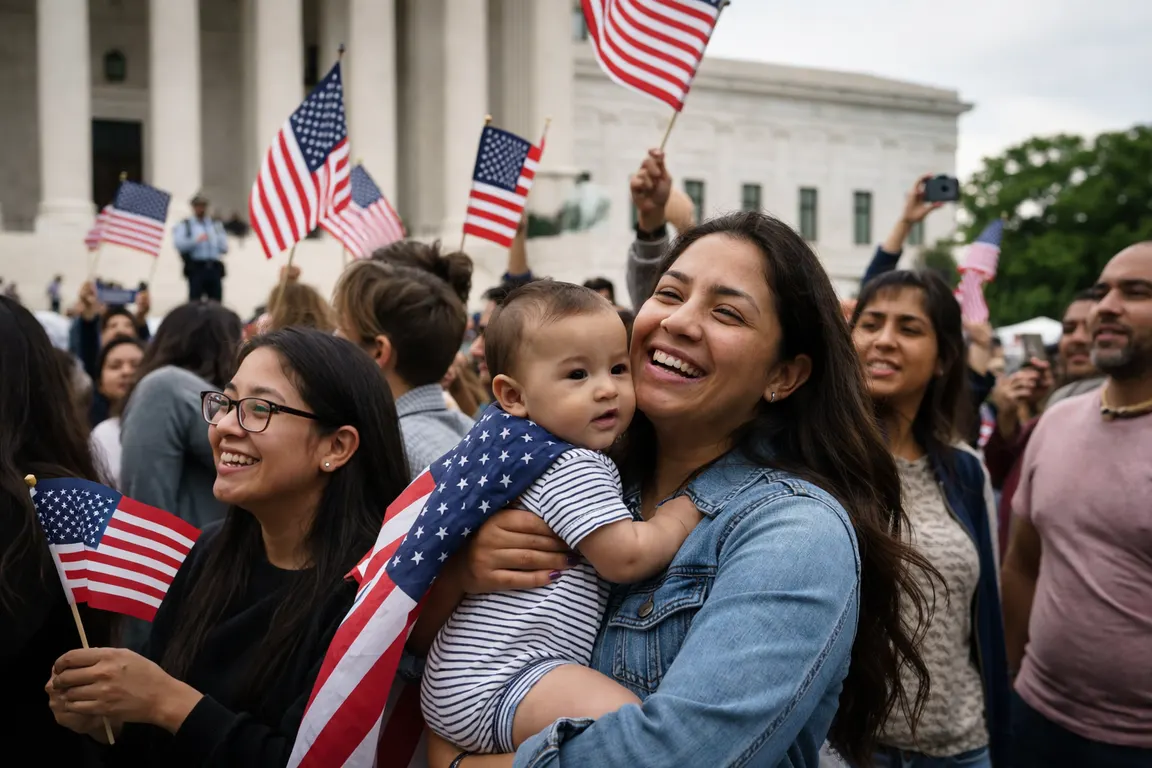
The Supreme Court has rejected the Trump administration's efforts to restrict birthright citizenship, ruling 6-3 to maintain the right to American citizenship for nearly everyone born on US soil. The decision, citing the Citizenship Clause of the 14th Amendment to the US Constitution, upholds a long-standing principle that has been in place since the 1898 case of Wong Kim Ark.
The Trump administration had attempted to restrict birthright citizenship through an executive order, which was blocked by lower courts before the Supreme Court's ruling. Despite the Supreme Court's decision, the administration plans to continue targeting 'birth tourism', a practice where foreign women travel to the US to give birth. Acting Attorney General Todd Blanche stated that authorities would still target these individuals.
The issue of birthright citizenship affects thousands of people, including undocumented immigrants, temporary residents, and their children. Over 250,000 children are born to undocumented immigrants or temporary residents in the US each year. The Trump administration has highlighted 'birth tourism' as a concern, particularly from China. However, experts state that 'birth tourism' occurs relatively infrequently compared to other forms of immigration.
The Supreme Court's decision has provided clarity on the issue of birthright citizenship, but the Trump administration's ongoing efforts to restrict it will likely continue to be a point of contention. The administration's plans to continue targeting 'birth tourism' have sparked controversy and uncertainty for those seeking to give birth in the US. As the Trump administration moves forward with its plans, the implications of the Supreme Court's decision for immigration policy remain unclear.
The Supreme Court's ruling referenced the 1898 case of Wong Kim Ark, which established that children born in the US are citizens by virtue of being born in the US. This decision has been upheld for over a century, and the Supreme Court's latest ruling reinforces this principle. The Trump administration's efforts to restrict birthright citizenship have been met with opposition from various groups, who argue that it is a fundamental right guaranteed by the US Constitution.
The estimated number of children born to undocumented immigrants or temporary residents in the US each year is significant, and the potential consequences for these children and their families are substantial. The Supreme Court's decision has provided clarity on the issue of birthright citizenship, but the Trump administration's ongoing efforts to restrict it will likely continue to be a point of contention in the debate over immigration policy.