

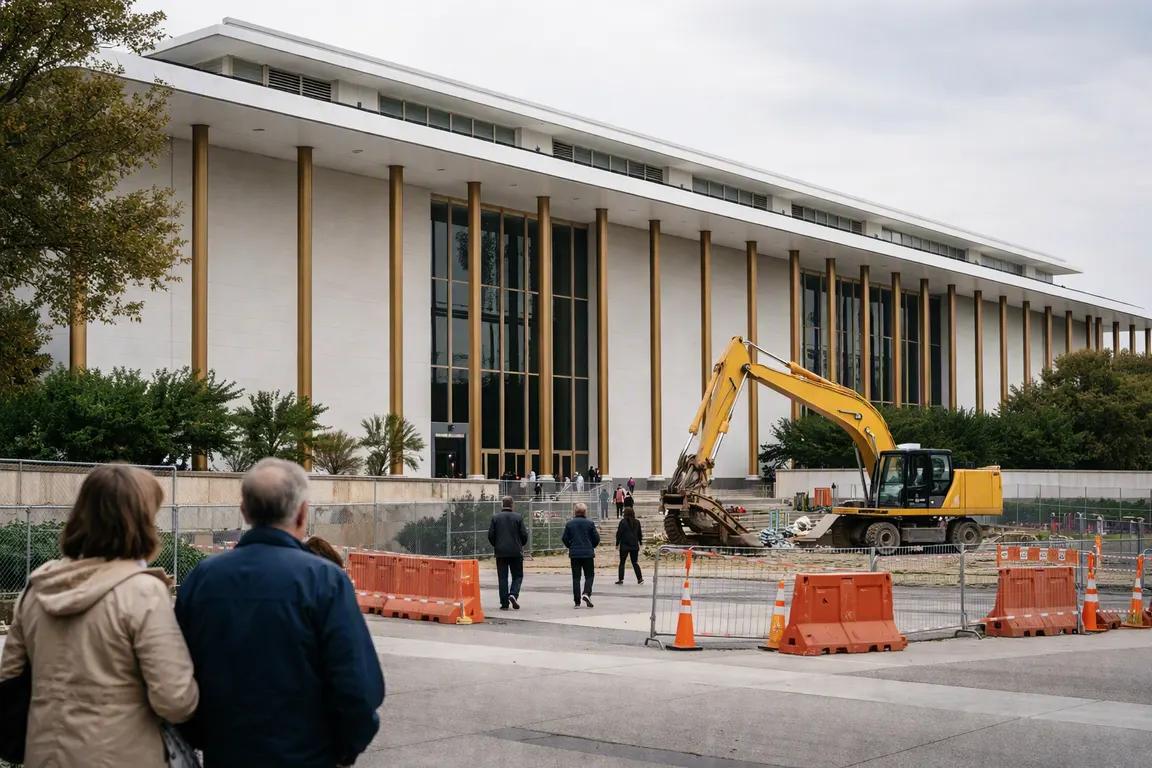
The Justice Department filed a brief Monday warning a federal judge that the John F. Kennedy Center for the Performing Arts could be demolished unless a $250 million Kennedy Center renovation and a naming‑rights agreement that would place former President Donald Trump’s name on the building are approved.
The department argues the venue cannot continue operating without extensive structural repairs and that private fundraising tied to a presidential naming right is essential to cover the cost. If a judge blocks the proposal, the brief says demolition becomes a viable option.
According to the filing, the center needs roughly $250 million to address structural and safety concerns identified in internal assessments, though the brief does not specify the deficiencies. The department links the renovation funding to a naming‑rights deal it says is necessary to attract private donations.
The Kennedy Center, a federally funded national performing‑arts venue on the Potomac River, has long relied on a mix of public appropriations and private contributions. The filing did not disclose the center’s operating budget or the precise nature of its infrastructure problems, leaving the urgency of the repairs unverified by independent engineering studies.
Media outlets have reported the $250 million figure, and some have highlighted the naming‑rights condition. A separate, unverified proposal to replace the existing building with an outdoor amphitheater overlooking the river has been mentioned in tabloid coverage, but no official design has been released.
If demolition proceeds, the impact would extend beyond the building’s walls. The center employs hundreds of staff, supports a national roster of performers, and generates significant tourism revenue for Washington, D.C. A renovation financed partly through a Trump‑branded fundraising campaign could set a precedent for leveraging public cultural assets for political fundraising, potentially reshaping how other institutions negotiate public‑private partnerships.
Legal scholars note that a judge will consider whether the department’s threat meets the standard for an injunction that would compel demolition. The brief makes demolition contingent on a court ruling that blocks the renovation plan; no decision has been issued. Without a judicial finding that the center poses an imminent safety risk, the threat remains speculative.
Arts organizations and local officials have called for transparent engineering assessments and for exploring alternatives that preserve the historic structure while addressing funding gaps. The outdoor amphitheater proposal, mentioned only in tabloid coverage, lacks official details and has not been evaluated for feasibility or community impact.
The case raises a broader question: how should the federal government balance preservation of cultural landmarks with the need for modern, safe facilities, and what role should private naming rights play in that equation? A hearing before the judge will examine both the department’s renovation request and the demolition contingency, determining whether the Kennedy Center proceeds with a costly overhaul, faces an uncertain future, or becomes a test case for naming‑rights‑driven fundraising at public institutions.