

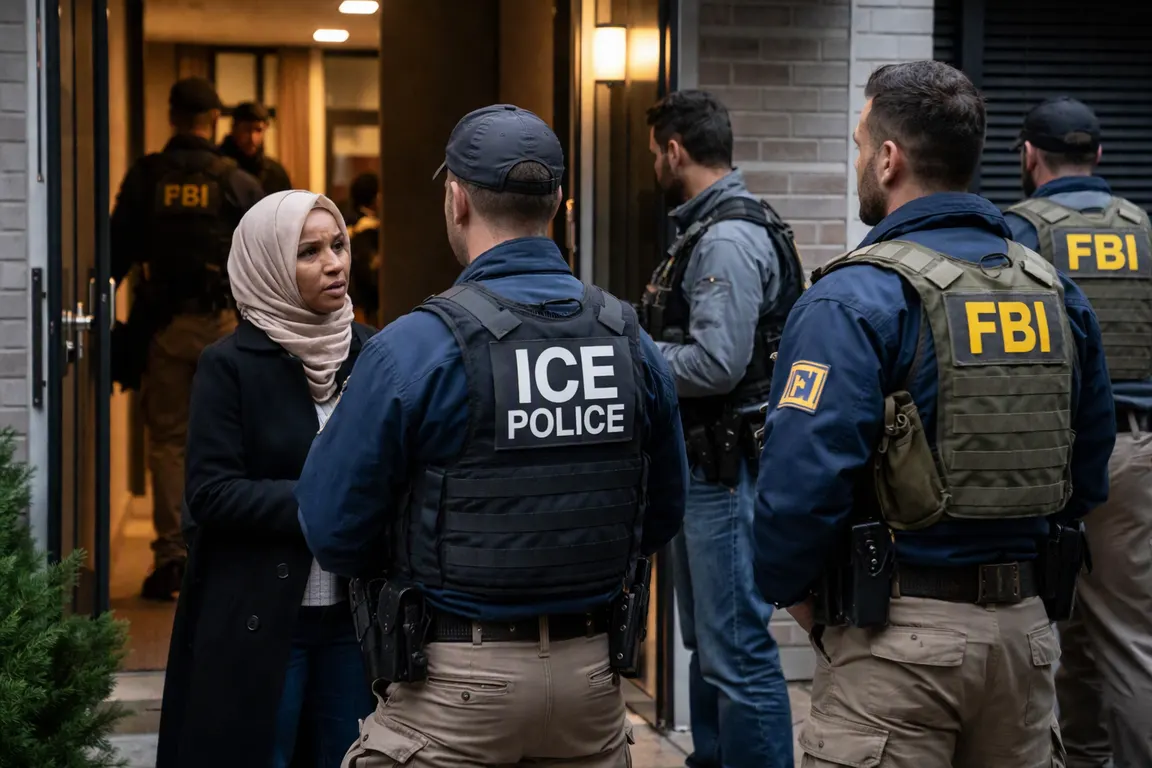
Federal immigration agents executed an Ilhan Omar search warrant at the Representative's Washington, D.C., residence on Monday morning. The operation, part of an undisclosed criminal investigation, has sparked a debate over law‑enforcement authority, due‑process protections, and the appearance of political influence just weeks before the November 2024 midterm elections.
Omar, who represents Minnesota’s 5th congressional district, said she would “not be silenced” and described the raid as an extension of former President Donald Trump’s intimidation campaign. Immigration and Customs Enforcement (ICE) confirmed only that agents were acting on a criminal probe and did not specify the alleged offense.
House Democratic leaders condemned the search. Minority Leader Hakeem Jeffries, Whip Katherine Clark and Caucus Chair Pete Aguilar called it “deeply disturbing” and warned of “weaponization” of the federal government. The Justice Department and ICE have not released the warrant, the supporting affidavit, or any charges.
Federal searches of a sitting member’s home are rare. Historical records show only a handful of such actions in recent congressional history, and none have drawn comparable national attention. The scarcity of precedent raises questions about the legal standard that justified the warrant, including the probable‑cause basis and whether any political considerations played a role.
Civil‑rights groups are demanding transparency. The ACLU urged the Justice Department to publish the warrant’s affidavit so the public can assess whether constitutional protections were observed. Legal scholars at Georgetown University noted that the Fourth Amendment requires a warrant to describe with particularity the place to be searched and the items sought, and they warned that insufficient disclosure could invite judicial review.
The timing amplifies the political impact. With the midterm ballot approaching, the incident may shape voter perceptions of both law‑enforcement agencies and elected officials. Constituents in Omar’s district, a diverse and heavily Democratic area, expressed anxiety about possible intimidation, while some Republican commentators framed the raid as evidence of a broader effort to target conservative allies, though no direct link to partisan motives has been substantiated.
Immigration agents operate under the Department of Homeland Security and must obtain a warrant signed by a federal judge. Because the warrant’s scope has not been made public, it is unclear whether the investigation concerns immigration‑related matters, a separate criminal matter, or a combination of both. Without that information, assessing the raid’s compliance with established civil‑rights safeguards remains difficult.
Beyond the immediate disruption to Omar’s office and staff, the episode could have a chilling effect on other elected officials who might fear similar interventions. Scholars of democratic institutions warn that perceived politicization of investigative tools can erode trust in law‑enforcement agencies and reduce public cooperation in unrelated cases.
Recent Pew Research polling shows confidence in federal law‑enforcement agencies has fallen to 48 percent, the lowest level in a decade. Incidents perceived as politically motivated tend to depress those numbers further, according to the survey’s analysis. The Omar raid arrives at a moment when public trust is already fragile.
The Justice Department has said it will not comment further while the investigation proceeds. As the midterm campaign intensifies, observers will watch for any additional disclosures about the warrant’s basis, which could clarify whether the search was a routine law‑enforcement action or a precedent‑setting intersection of political power and federal authority.