

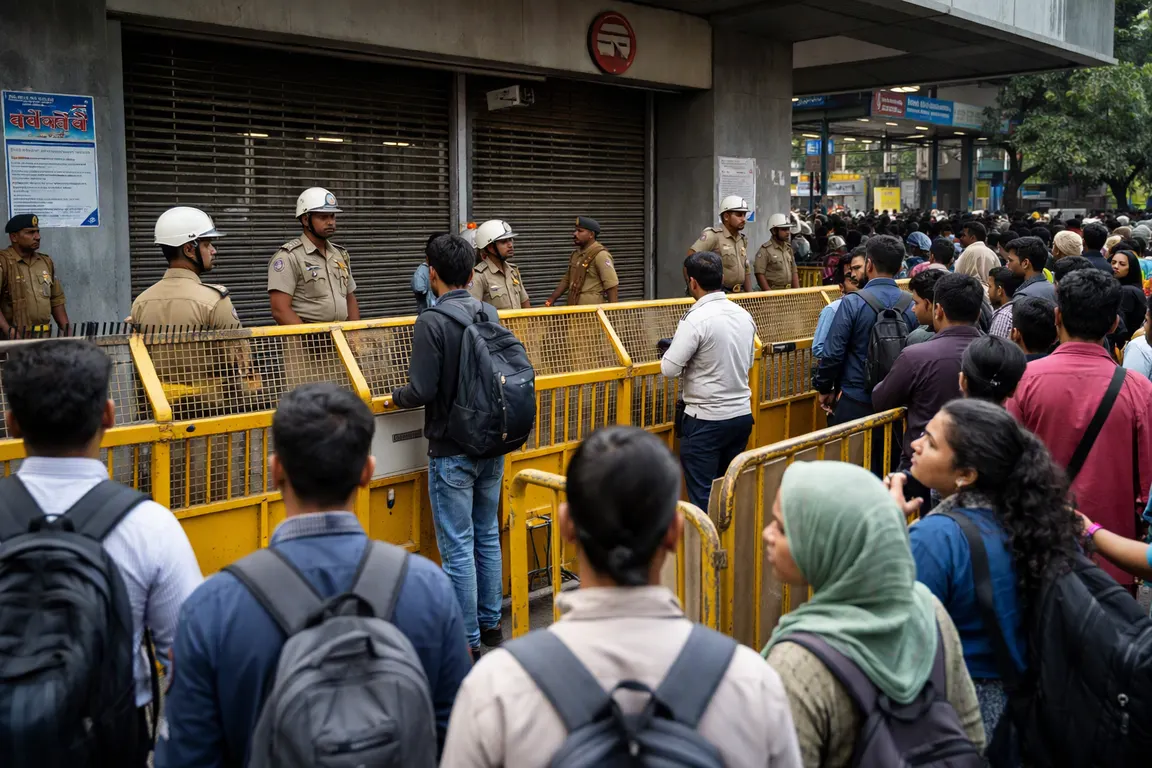
Delhi metro station closures were implemented on Monday as police prepared for a flash‑march to the Supreme Court. The six closed stations—on the Red, Yellow and Blue lines—prompted warnings of heavy traffic and urged commuters to seek alternative routes.
The action follows a weekend of demonstrations by opposition parties and student groups demanding the resignation of Chief Election Commissioner Gyanesh Kumar. Protesters claim a recent revision of voter rolls removed thousands of names from areas that traditionally support the ruling Bharatiya Janata Party, potentially affecting future elections.
Opposition leaders have filed a petition with the Supreme Court seeking a court‑ordered removal of Kumar, a step that has never been taken in modern Indian democracy.
Flash‑marches erupted across the capital over the weekend, with students and party activists converging on key intersections. Police detained participants, though exact numbers have not been released. Authorities say the detentions were made under public‑order statutes that prohibit assemblies deemed a threat to safety.
In response, the Delhi administration deployed several thousand additional police and paramilitary forces to routes leading to the court.
Commuters felt the impact immediately. The closures forced travelers to seek alternative routes, lengthening journeys by up to an hour during peak hours. Traffic police warned that congestion could spill onto major arterial roads, disrupting deliveries and affecting businesses that rely on foot traffic near the stations. Vendors and shop owners in the affected neighborhoods reported a sharp drop in customers, raising concerns about revenue losses if the closures continue.
The protest movement also includes members of a loosely defined “cockroach” youth group, a term used by some outlets to describe activists who organize rapid, dispersed actions. The composition of the group remains unclear, and officials have not commented on its role.
No government spokesperson has offered a detailed rationale for the security measures, nor has any official statement confirmed whether Kumar will consider resignation. The opposition’s demand is limited to a petition for the Supreme Court to order his removal, citing alleged bias in the voter‑list revision. Legal precedent for removing a chief election commissioner is scant; the position has traditionally been insulated from political pressure.
The disruption highlights how procedural disputes can ripple through urban life, affecting transport, commerce and public confidence. As the Supreme Court hearing approaches, authorities face the dual task of maintaining order while preserving essential services. The outcome of the petition could set a benchmark for how India’s electoral institutions respond to allegations of partisanship and whether similar security crackdowns will become a feature of future political protests.