

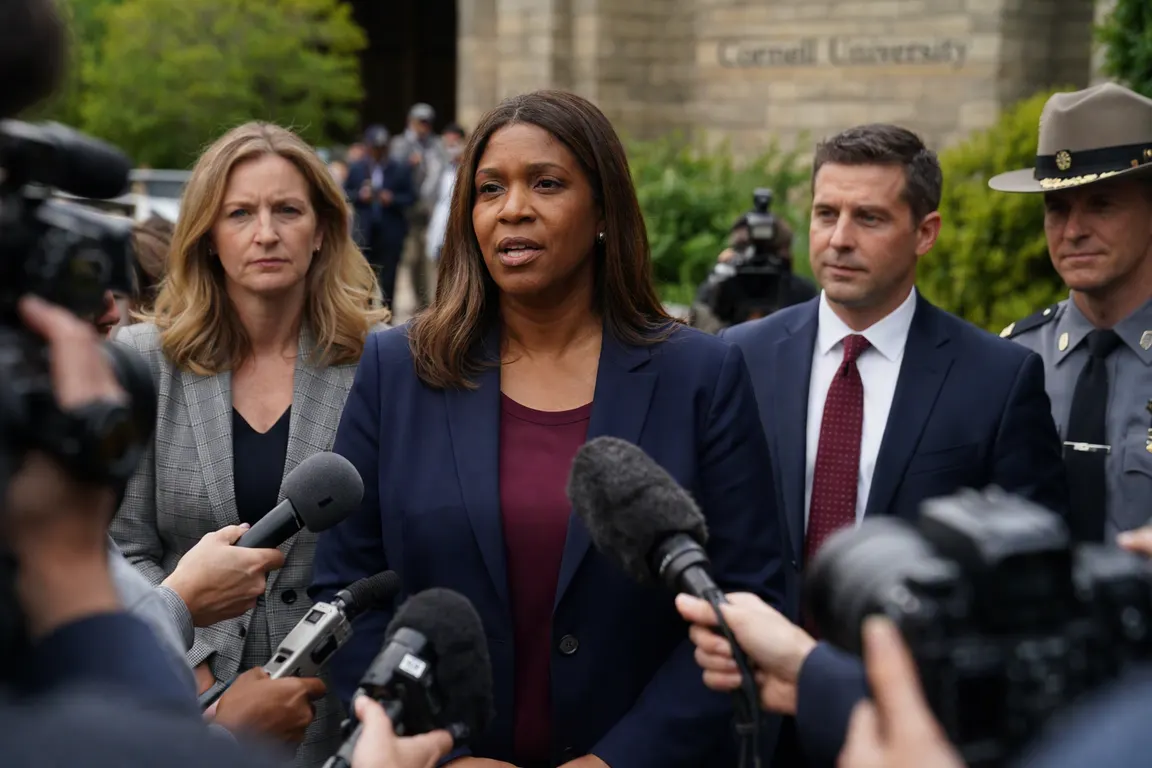
Governor Kathy Hochul announced Thursday that Attorney General Letitia James will serve as special prosecutor in the Cornell sexual assault investigation. The appointment follows criticism that Tompkins County police and District Attorney Matthew Van Houten failed to protect the complainant, identified in court filings only as “Jane Doe.”
The move elevates a campus dispute to a statewide criminal investigation, opening the possibility of a grand‑jury hearing and prompting other universities to review how they handle sexual‑assault allegations. State oversight could also reshape the relationship between local prosecutors and higher‑education institutions across New York.
The alleged assault occurred in 2024 at the Chi Phi fraternity house. Jane Doe reported the incident to Cornell campus police in November 2024. An internal university investigation closed the case without charges later that year. After the victim filed a civil lawsuit naming seven fraternity members, the university and the fraternity as defendants, Tompkins County DA Van Houten reopened the criminal inquiry. Hochul said the victim was “failed by people and institutions with an obligation to protect her,” citing the police and district attorney as part of that failure.
A special prosecutor differs from a local district attorney in several key ways. The AG can draw on state investigative resources, issue subpoenas beyond the county’s jurisdiction, and operate independently of local political pressures. James will oversee the new criminal probe, review evidence gathered by campus police and state‑law‑enforcement partners, and, if warranted, present the case to a grand jury.
Next steps likely include a comprehensive review of forensic reports, interview transcripts and the civil‑suit filings. James’s team may re‑interview witnesses and request additional evidence from Cornell’s Title IX office. If a grand jury finds probable cause, formal charges could be filed against the fraternity members named in the lawsuit, exposing them to state felony penalties, possible imprisonment and sex‑offender registration.
Cornell’s administration has signaled a willingness to examine its policies. The university’s Title IX coordinator told reporters the case “highlights gaps in our response protocols,” and announced a task force to assess reporting mechanisms, evidence preservation and survivor support services. Faculty members have called for clearer guidelines on fraternity oversight and mandatory training on consent and drug‑facilitated assault.
Legal scholars note that New York law allows the governor to assign the AG as a special prosecutor in matters of “significant public interest,” but caution that frequent use could strain relations between state and local authorities. The appointment raises the broader question of whether state‑level intervention will become a standard response when local prosecutors are perceived to have mishandled campus sexual‑assault cases.
James is expected to issue a formal statement within the next week outlining the scope of the probe. The investigation will test the balance between university autonomy, local prosecutorial discretion and state oversight, while the outcome for the alleged victims and defendants remains pending.