

G20 oil trade measures reshape markets and China policy
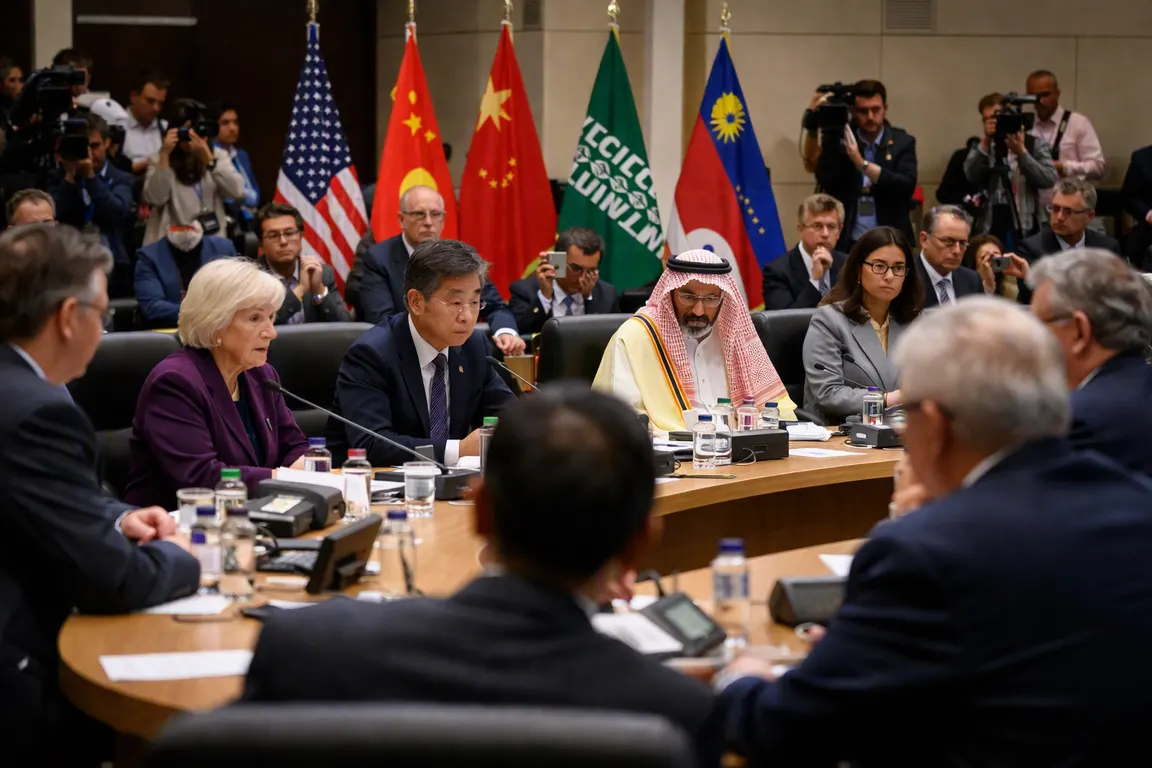
The United States and its G20 partners announced a coordinated set of actions on Sept. 1 aimed at curbing China’s export‑driven growth, rerouting Middle‑East oil away from the Strait of Hormuz, and securing U.S. control of Venezuelan oil fields. The announcements, made at a finance ministers’ meeting in Asheville, North Carolina, lifted oil prices and pushed Treasury yields to multi‑year highs, creating immediate turbulence for investors, exporters and consumers worldwide.
Treasury Secretary Scott Bessent used the Asheville forum to outline a three‑pronged strategy: tighter curbs on Chinese goods, an overland pipeline network to bypass Hormuz, and pressure on Japan’s central bank. He warned that “growth is the only way out of heavy debt” and urged allies to address China’s trade surplus, which he said accounts for about 1 % of global GDP. President Donald Trump simultaneously announced a U.S.–led deal that would give America majority control of 65 billion barrels of Venezuelan oil across 17 fields, promising $100 billion in investment and $209 billion in tax revenue for Caracas over 25 years.
The trade component is already materializing. Australia imposed tariffs on Chinese‑manufactured train wheels, and New Zealand’s aluminum‑extruder sector is lobbying for import restrictions on Chinese aluminum. European Commission President Ursula von der Leyen warned the EU could deploy anti‑coercion tools if China’s trade deficit is not reduced. Russia’s finance minister attended the G20, adding diplomatic friction among Western ministers.
Bessent’s most ambitious claim was that the Strait of Hormuz could become “a worthless piece of water” within two years as oil is rerouted through a network of pipelines, including a $15 billion Iraq‑Syria line slated for a four‑year build. Hours later, two super‑tankers were struck in the strait, lifting Brent crude above $92 a barrel and West Texas Intermediate above $87. While the pipeline timeline is plausible, security and construction risks remain, and analysts caution that regional instability could cause delays.
Financial markets reacted sharply. S&P futures slipped 0.6 %, Nasdaq futures fell 1.2 %, and the U.S. 10‑year Treasury yield rose to 4.79 %, its highest level since January 2025. Japanese 10‑year bonds breached 3 % for the first time since 1996. Diesel margins surged past $100 a barrel, while gold retreated roughly 6 % from its August peak. Higher oil prices combined with tighter credit conditions threaten to raise borrowing costs for governments and corporations, pressuring corporate financing and sovereign debt servicing.
The Venezuelan agreement, billed as “no cost to taxpayers,” lacks detail on financing mechanisms or congressional approval, leaving its legal feasibility uncertain. Nevertheless, U.S. control of a sizable share of the world’s light‑sweet crude could reshape Europe’s energy calculus, potentially limiting access to traditional sources and prompting a search for alternative suppliers.
Looking ahead, the success of the Iraq‑Syria pipeline will hinge on security guarantees and meeting the projected two‑year timeline. In Washington, Congress is expected to scrutinize the Venezuelan oil deal in the coming weeks, while the next G20 summit will likely revisit the broader trade strategy toward China. How these policies unfold will determine whether the coordinated push translates into lasting shifts in global oil supply, trade flows, and financial stability.