

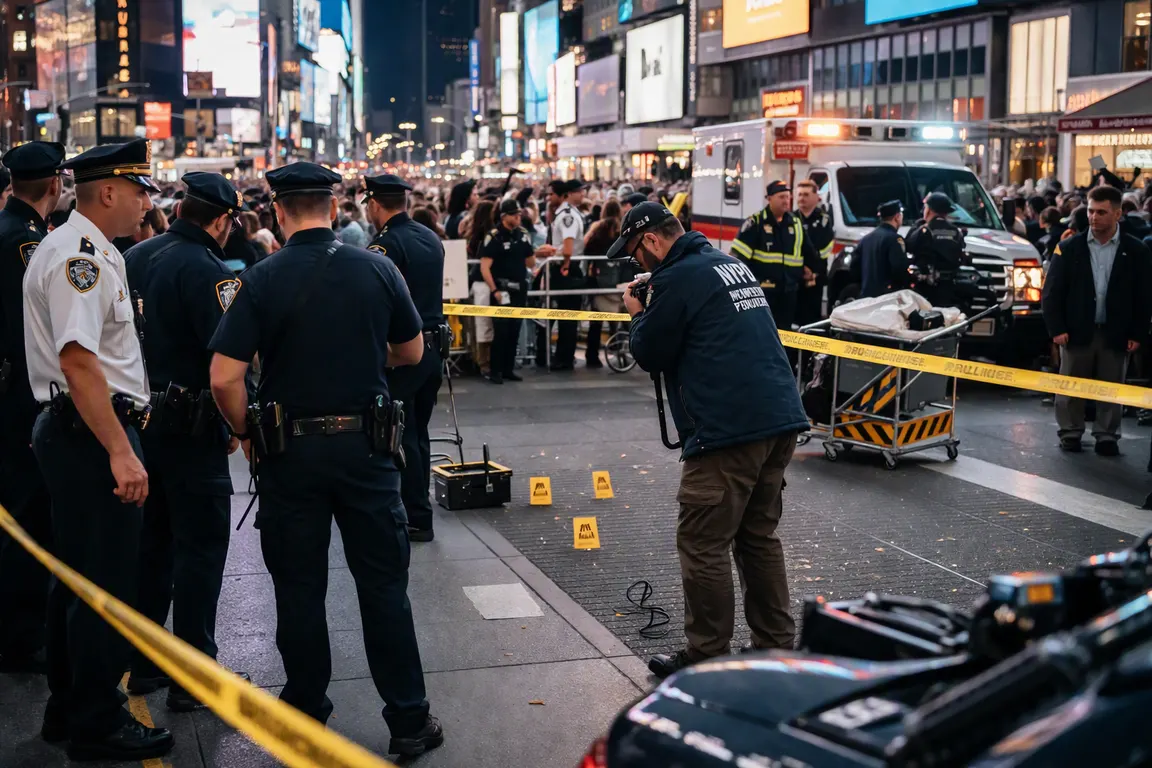
A Times Square stabbing of a Bank of America vice‑president shocked the city on Monday night, prompting officials and employers to reexamine security in the bustling pedestrian corridor.
Erin Piacenti, a 32‑year‑old University of Pennsylvania graduate from Chester, New Jersey, was attacked near the intersection of Broadway and Seventh Avenue. Police say an unidentified assailant thrust a knife into Piacenti and a second, unnamed victim. Piacenti died at the scene; the condition of the other person has not been released. Emergency vehicles swarmed the area, streets were temporarily closed, and investigators are treating the incident as a homicide. Bank of America confirmed Piacenti’s role, expressed condolences and called the attack “random.” No motive or suspect has been identified.
The killing highlights growing anxiety about public safety in high‑density environments where cameras and police presence are assumed to deter violence. Times Square, a magnet for tourists, commuters and theatergoers, is one of the most heavily monitored public spaces in the United States, yet the incident shows that a lone attacker can inflict lethal harm before law‑enforcement can intervene.
City officials have already signaled a review of resource allocation for foot‑traffic hotspots. Police Commissioner Edward Caban told reporters the department will assess “the adequacy of patrols, the placement of emergency call stations, and coordination with private‑sector security teams” in areas like Times Square. The mayor’s office is expected to convene a task force that includes the Department of Transportation, the Office of the Comptroller and major property owners to examine lighting, crowd‑control barriers and rapid‑response protocols for a 24‑hour urban hub.
Private employers with a high concentration of staff in Midtown are also likely to revisit safety plans. Bank of America has not announced specific changes, but its statement said the firm will “continue to work with local authorities to ensure the safety of our employees.” Other financial institutions and corporations nearby have begun internal audits of visitor‑screening procedures and are considering additional emergency‑response training for staff.
The lack of a suspect or clear motive leaves investigators with limited leads. Police have not released a description of the attacker, and no prior threats against Piacenti were reported. The case raises broader questions about how law‑enforcement can pre‑empt random violence without infringing on civil liberties or creating an atmosphere of over‑security.
For the public, the immediate impact was palpable. Foot traffic in Times Square dipped in the hours after the stabbing as commuters avoided the area, and several nearby businesses reported a short‑term loss of sales. Tourism officials warn that repeated high‑profile crimes could erode the city’s reputation as a safe destination, especially if visitors perceive a pattern of unchecked violence in iconic locales.
As the investigation proceeds, officials have pledged to release any new findings on the attacker’s identity and to outline concrete policy adjustments within the coming weeks. Until then, the Times Square stabbing remains a stark reminder that even the most visible urban arteries can harbor hidden vulnerabilities, and that public‑safety strategies must evolve to address the unpredictable nature of random violence.