

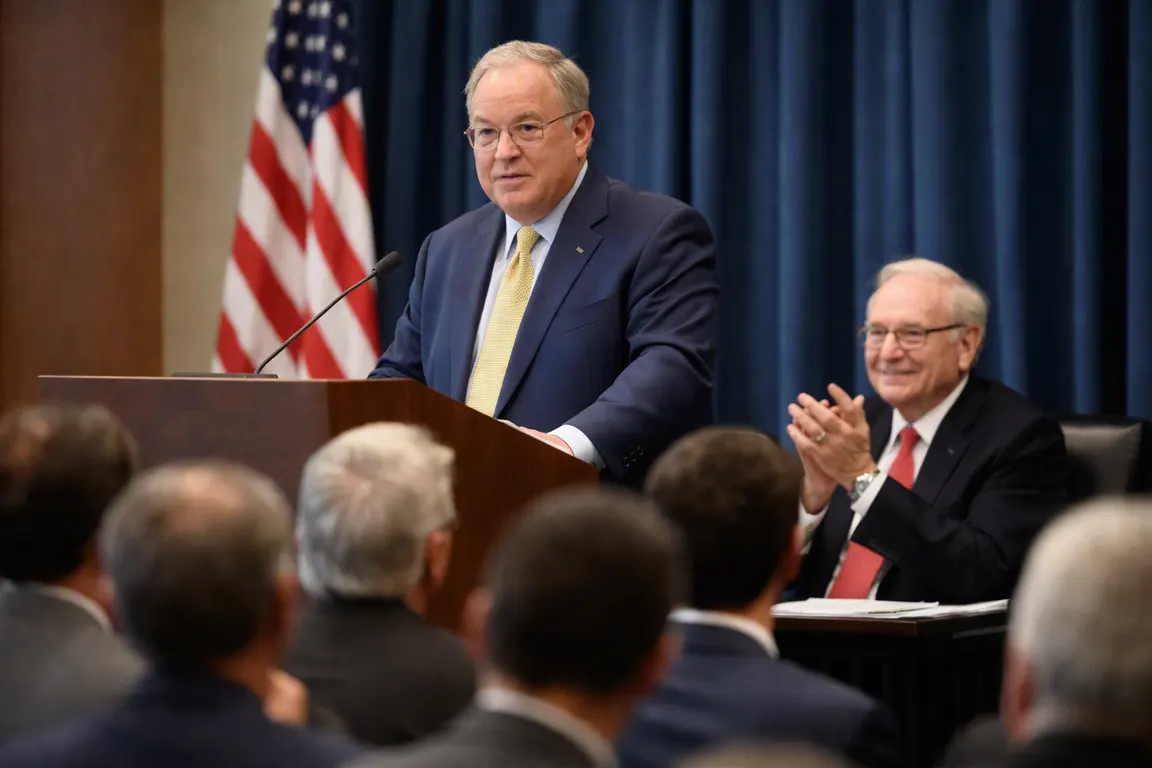
Berkshire Hathaway announced Friday that Howard Buffett will assume the chairmanship, while founder Warren Buffett, 96, moves to a chairman‑emeritus role. The change ends a 56‑year tenure as chairman and makes Howard Buffett the first family member to hold the position.
Howard Buffett, a board member since 1993 and the son of the late philanthropist Howard H. Buffett, will oversee board oversight of risk and culture. Greg Abel, who became chief executive at the start of 2024, will continue to run day‑to‑day operations.
Warren Buffett first became chairman in 1970 after transforming Berkshire from a struggling textile firm into a diversified holding company. Over five decades he built a reputation for disciplined capital allocation, decentralized management and a long‑term investment horizon that generated an average compounded annual return of 19.9%, well above the S&P 500’s 10.4% over the same period.
In pre‑market trading, Berkshire shares slipped modestly, reflecting investors’ cautious assessment of the leadership shift. Analysts said the move does not immediately affect the company’s dividend policy or portfolio holdings, but noted that the chairmanship carries responsibility for board oversight of risk and culture.
The transition revives debate over the length of Warren Buffett’s service. While some outlets have cited “over 60 years,” Berkshire’s filings confirm a 56‑year chairmanship that began in 1970.
No concrete policy changes have been announced under Howard Buffett’s chairmanship. In a recent interview, he pledged to “preserve the culture of integrity, patience and analytical rigor” that his father championed, but offered no specifics on investment criteria or governance adjustments.
For shareholders, the primary concern is continuity of governance and its impact on long‑term returns. Institutional investors may reassess holdings if they perceive a weakening of Berkshire’s decision‑making framework. Employees, accustomed to a decentralized structure that rewards autonomy, will watch for any shifts in leadership style that could affect morale or internal processes.
Beyond Berkshire, the change matters to the broader economy because the conglomerate’s holdings span insurance, railroads, utilities and consumer brands. Even modest strategic adjustments could ripple through these sectors, influencing credit markets, commodity pricing and employment.
Berkshire’s next board meeting, scheduled for later this month, will be the first under Howard Buffett’s chairmanship. The meeting should reveal how the new leader plans to safeguard the company’s culture while navigating any strategic tweaks. The outcome will provide the most concrete gauge of whether the transition will preserve Berkshire’s historic stability or usher in a new operational era.