

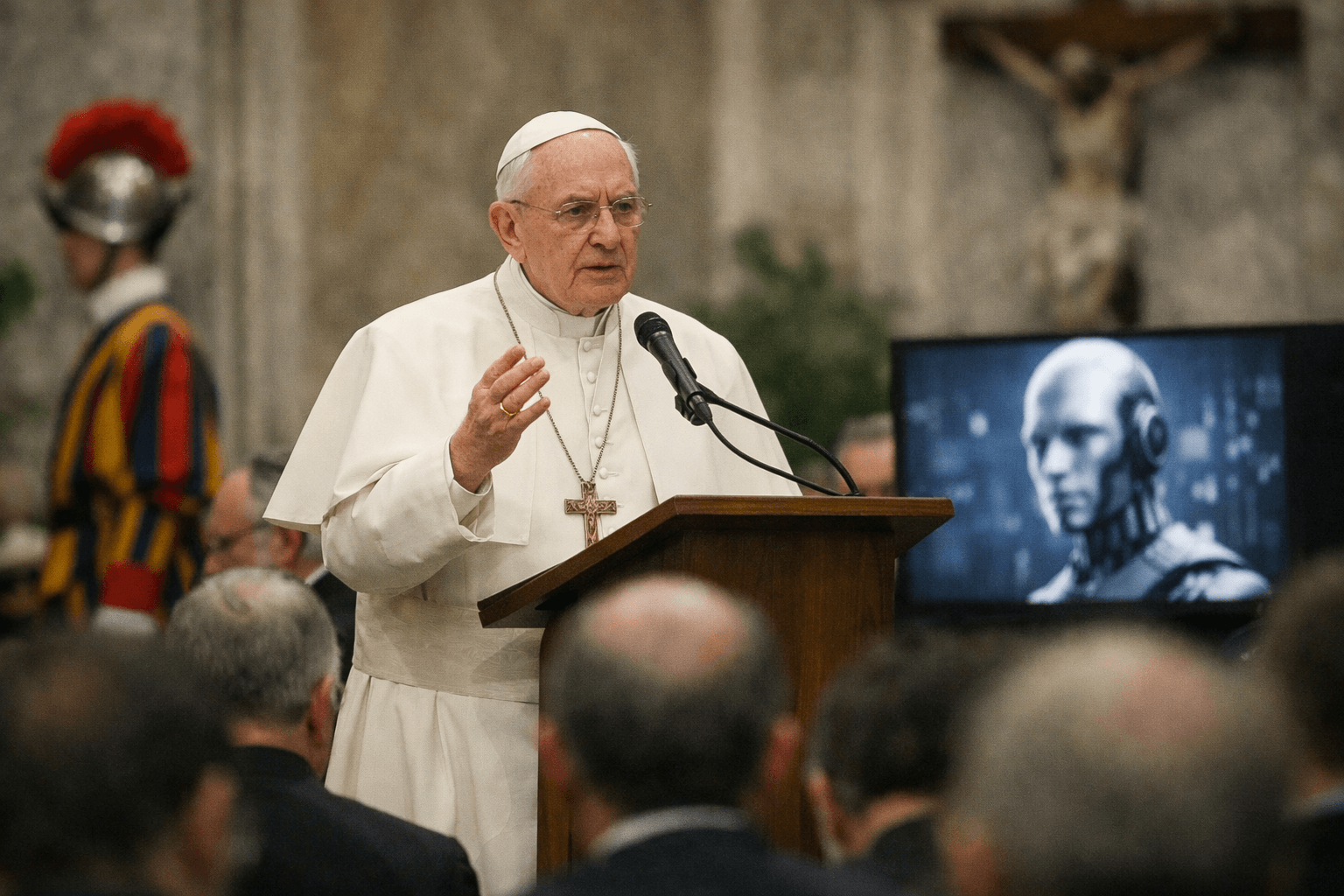
In a bold move, Pope Leo XIV has issued a clarion call to 'disarm' artificial intelligence, warning that its unregulated development could lead to a 'destructive spiral' of domination, exclusion, and death. The Pope's first encyclical, 'Magnifica Humanitas,' highlights the critical need for ethical considerations in AI development, particularly as the technology is projected to reach a value of $4.8 trillion by 2033. With the potential consequences for humanity hanging in the balance, the Pope's influential voice is shaping the global conversation around AI ethics and responsible development.
The rapid development of artificial intelligence has raised concerns about its potential impact on humanity, including job displacement, biased decision-making, and the potential for autonomous weapons. As the United Nations Secretary-General, Antonio Guterres, has warned, 'the window is closing to shape AI -- for peace, for justice, for humanity.' The Pope's encyclical comes at a time when the world is grappling with the implications of AI on individuals and communities, from workers who may lose their jobs due to automation to communities that may be disproportionately affected by biased AI decision-making.
The Pope's encyclical emphasizes the need for 'digital literacy' to understand how algorithms shape our perception of reality and the importance of transparency in AI development. The Vatican has been studying AI-related technologies since 2020, launching the 'Rome Appeal for an AI Ethic' to promote human dignity in the development of new technologies. Pope Leo XIV's predecessor, Pope Francis, also spoke extensively on the need for AI regulation, warning that it could exacerbate inequalities. The Pope's call to 'disarm' AI is an extension of the Church's social teachings on 'protecting people in the AI era' and may prove as influential as Pope Francis's 2015 climate manifesto, 'Laudato Si'.
To regulate AI development and ensure that it serves humanity, specific steps can be taken, such as implementing robust testing and validation protocols, establishing transparent decision-making processes, and promoting diversity and inclusion in AI development teams. Individuals and communities can develop the necessary 'digital literacy' by critically evaluating AI-generated content, seeking out diverse perspectives, and engaging in ongoing education and training. The role of religious leaders like Pope Leo XIV is crucial in shaping the global conversation around AI ethics and responsible development, as they can bring a moral and ethical framework to the discussion. The potential consequences of failing to address the ethical challenges posed by AI are dire, ranging from widespread job displacement to the exacerbation of existing social inequalities.
The Pope's warning serves as a wake-up call for the world to take action and ensure that AI development is guided by human values and ethics. As the world hurtles towards an AI-driven future, it is imperative that we prioritize transparency, accountability, and responsibility in AI development to create a more equitable and just future for all. The Pope's call to 'disarm' AI is a call to action, urging us to reexamine our relationship with technology and to prioritize human dignity and well-being above all else.