

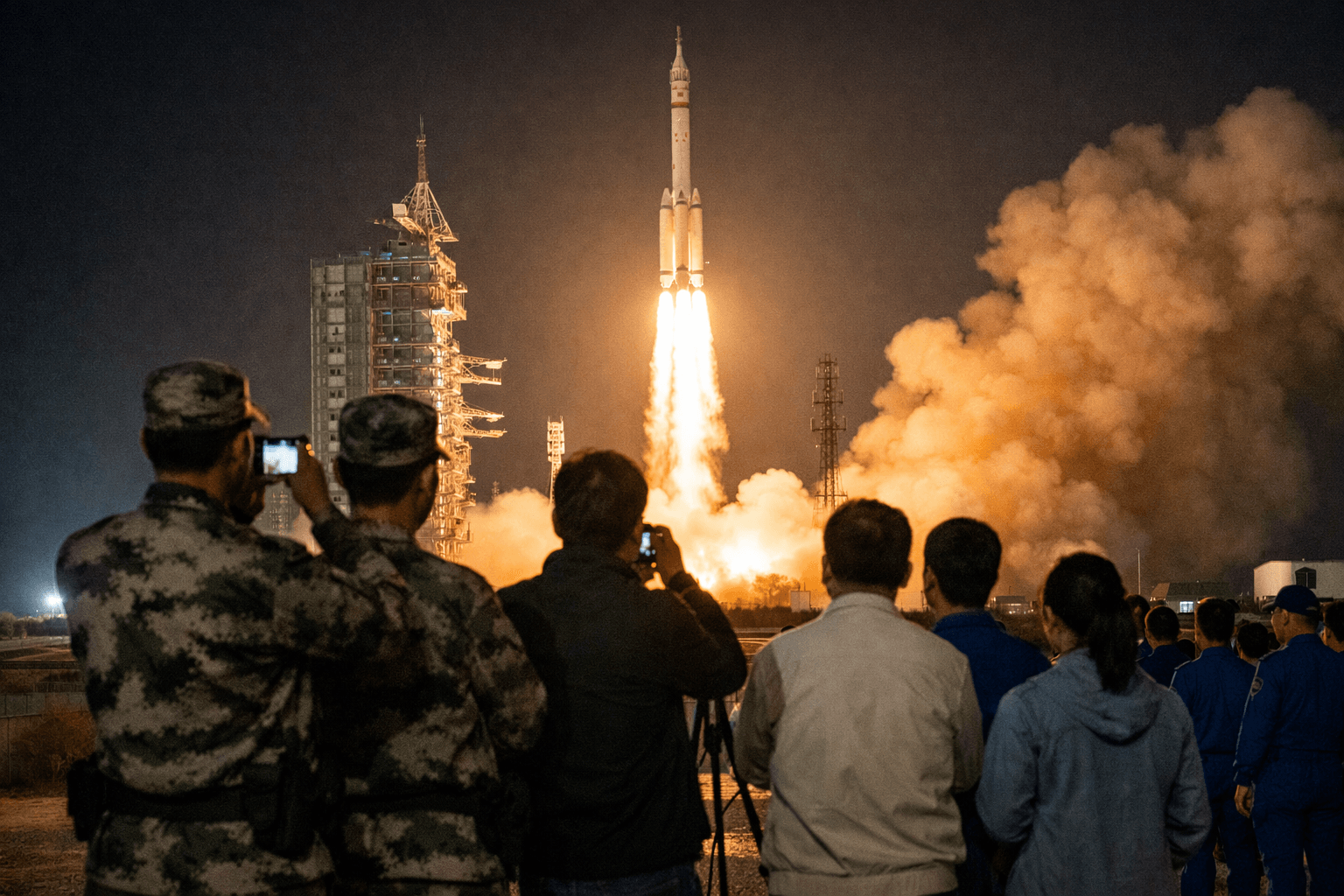
China's Shenzhou 23 spacecraft soared into the night sky from the Jiuquan Satellite Launch Center, carrying three brave astronauts on a historic mission to the Tiangong space station. This mission marks a significant milestone in China's space program, with one of the astronauts set to stay in space for a year, exploring human adaptability and performance limits in long-duration spaceflight environments. Lai Ka-ying, a 43-year-old police officer and mother of three from Hong Kong, is part of the historic crew, symbolizing China's efforts to integrate the special administrative region into its national projects.
China's space program has been rapidly advancing, with significant milestones including the development of the Tiangong space station, which first hosted Chinese astronauts in 2021. The country's exclusion from the International Space Station due to US national security concerns has driven its independent space station program. The success of missions like Shenzhou 23 is crucial for China's long-term space exploration goals, including lunar and potentially Mars missions.
The crew of the Shenzhou 23 spacecraft will conduct dozens of science and application projects, including experiments on microgravity and space-based astronomy. Lai Ka-ying, who holds a doctoral degree in computer forensics, will serve as the team's payload scientist, overseeing the deployment of various scientific instruments and equipment. The mission will also include an in-orbit rotation with the crew of Shenzhou 21, demonstrating China's capabilities in spaceflight operations and crew management. The astronaut staying in space for a year will face unprecedented challenges, including prolonged exposure to microgravity, radiation, and isolation, which will provide valuable insights into human adaptability in space.
The inclusion of Lai Ka-ying in the mission reflects China's strategy for integrating Hong Kong into its national space program, which may have implications for the region's political and social landscape. As the first Hong Kong astronaut, Lai Ka-ying's participation symbolizes China's efforts to promote national unity and cooperation in space exploration. The success of the Shenzhou 23 mission could pave the way for future collaborations between China and Hong Kong in space research and development. China's timeline for achieving a crewed lunar landing by 2030 compares with the US's plans for lunar exploration, which may lead to a new era of space competition and cooperation between the two nations.
The launch of the Shenzhou 23 spacecraft marks a significant step forward for China's space program, with far-reaching implications for human spaceflight and international cooperation in space exploration. As the world watches the mission unfold, it remains to be seen how China's ambitious space goals will shape the future of space travel and exploration.